

Wartime mobilization, media and unequal participation
Compare media and ideological mobilization in both world wars without equating participation or compliance with belief.
Your task: Compare media and ideological mobilization in both world wars without equating participation or compliance with belief.
Open the investigation · Read the explanation · Your saved evidence
Starting recap and vocabulary
Existing war, Soviet/Chinese, interwar and decolonization work is credited; this package does not expand ancient or college-I requirements.
- Mobilization
- The organization of people and resources for a collective purpose.
Does participation establish belief?
Complete the source-specific private actions and independent comparison, then revise under the explicitly hypothetical changed condition before opening feedback.
Explain a dated mechanism and identify one unsupported inference.
Make a provisional claim
Loading saved evidence…
Inspect evidence and test an explanation
The investigation controls appear when your local evidence is ready.
Connect evidence and mechanism
Wartime mobilization, media and unequal participation
A message is an attempt, not its measured effect
A fictional museum label says, “This patriotic poster proves everybody supported the war.” Predict the missing evidence. A government can publish a message without persuading every reader; a person can contribute labor without accepting the government’s ideology. Participation, motivation and political freedom require different evidence.
The course treats the First World War as the first total war in its modern global-industrial framework: governments mobilized production, finance, civilian labor and imperial resources on an unprecedented scale. That does not mean earlier wars left civilians untouched. The Second World War intensified this reach. Return to production, colonial resources and the amount/share distinction before interpreting evidence of scale. “Total” describes the reach of mobilization, not literal unanimity or proof that every resource was actually used.
All tasks are private historical analysis. Do not produce propaganda, adopt an extremist role, design recruitment or reenact wartime activity. The accessible summaries below avoid graphic and operational passages in longer sources.
WWI home-front media: belonging, food and official authority
Charles Edward Chambers’s 1917 poster for the United States Food Administration is cataloged by the Australian War Memorial as ARTV00391. The museum describes immigrants arriving in New York harbor, the Statue of Liberty and a rainbow. Its text connects preservation of freedom with conserving food for the Allies. This is an attributed description of the artwork, not a claim that we inspected the museum’s original sheet. The catalog identifies several language versions, reminding us that “the home population” was not a single-language audience.
The artistic association is important: an image of arrival and liberty gives an ordinary household decision a national meaning. That is an interpretation of the described composition, not evidence of every immigrant’s response. A state may appeal to gratitude and belonging while residents retain different experiences of discrimination, economic pressure and political commitment.
For an actually inspected printed artifact, examine the National Archives’ small public image of the Without Wheat pamphlet, from its Food Administration conservation records, 1917–1920. The readable top hierarchy names the United States Food Administration, subordinate New York food bodies, and the pamphlet’s subject. Dense recipe-style text follows. The available image is small; do not infer wording you cannot read, and do not assign it a more precise issue date from this reproduction.
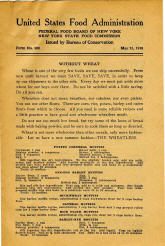
Accessible visual equivalent: a single portrait-oriented printed sheet places official agency names above a centered subject heading, then arranges practical household information beneath it. Unlike a speech transcript, its layout makes a state institution appear within a familiar domestic genre. The source is analyzed as communication, not used as a dietary or cooking instruction. No cooking activity is required.
The National Archives’ separate contextual account describes multilingual communication and distribution of substitute-food pamphlets. That supports an implemented communication effort, but distribution is not a measured change in consumption. Even if a consumption total changed, prices, availability and regulation would also need consideration before attributing the whole change to a poster.
Private action: Identify one symbolic appeal in the museum’s poster description and one authority cue in the inspected pamphlet. Explain how each connects civilian life to the war. Then name the additional evidence needed to support the fictional claim that everyone was persuaded.
Colonial participation through an individual voice
The home-front appeal cannot stand in for the experiences of colonial subjects. Read the British Library curator’s presentation of Indian soldiers’ letters through Europeana. It identifies a 24 May 1916 letter by Gholam Rasul Khan to his father in Bihar, preserved in the censor’s translated extracts, IOR/L/MIL/5/826/5, folio 711. The presented passage values a family photograph and expresses longing for home. It supplies a personal concern that a recruitment or conservation message would not measure.
The provenance matters. These are curated extracts mediated through military censorship and translation; some correspondence also passed through scribes. The curator explains that officials used reports to assess morale and feared political repercussions in India. We have read the public presentation and its quoted passage, not inspected the whole manuscript file. Do not silently convert its English extract into the soldier’s unmediated original language.
Private action: Compare the family-centered concern with the poster’s state-centered appeal. Identify one difference of purpose and one reason neither represents all soldiers or all immigrants. Explain why censoring correspondence is also evidence about institutions of wartime control. Do not assume the letter either endorses or rejects every aim of British rule.
Feedback: different concerns can coexist
A person might serve while longing for family, responding to material circumstances, valuing comrades or holding political views not disclosed in one surviving extract. A strong answer does not diagnose the author or infer a population’s loyalty from one letter. It distinguishes the institution’s attempt to mobilize people from an individual’s recorded concern and explains how selection, translation and censorship limit access to that voice.
WWII ideology and the organization of everyday life
Compare two public statements without treating their ideologies as identical. Stalin’s 3 July 1941 radio address, after the German invasion of the Soviet Union, appears in the 1946 Foreign Languages Publishing House collection reproduced by HyperWar. The bounded relevant passages, printed pages 12–14, demand reorganization of work for war, invoke Lenin and patriotic defense, and threaten punishment for people the regime labels obstructive. This is the Soviet leader’s public argument in an official retrospective English edition, not an independent report that all peoples enjoyed freedom or prosperity. Its military instructions are outside this task.
The speech combines communist authority with defense of a homeland. These appeals are not mutually exclusive: governments can connect class ideology, state loyalty and national survival. The existing Soviet institutional and rural evidence prevents a public claim about freedom from erasing previously documented coercion. Wartime threats also connect labor allocation with restrictions on expression and dissent; evidence of actual enforcement must remain distinct from the threat itself.
Joseph Goebbels’s 18 February 1943 Sportpalast speech, in the German Historical Institute’s translated excerpt, demands longer work, greater mobilization of women and punishment for alleged obstruction. He presents an invited audience as representative of the whole nation. That rhetorical move is not a representative sampling procedure. The edition identifies the German newspaper publication and a 1969 English translation; no lengthy translated passage is reproduced here.
In Nazi rule, fascist leadership claims and racial exclusion structured coercive mobilization. The existing comparison of interwar institutions already establishes repression and discrimination; the speech is additional evidence of a wartime appeal, not the beginning of totalitarian rule. State demands could regulate work, association and public expression, and the institutions enabling coercion did not automatically disappear when a particular campaign ended. This does not make all wartime states equally repressive or erase differences between Nazi racial ideology and Soviet communist claims.
Private action: For each speech, identify an appeal to legitimacy, a demand on daily life and a restriction or threatened sanction. Mark each as public demand, not measured implementation. Explain why a cheering invited audience and a leader’s assertion about an entire people cannot establish unanimous consent.
Colonial scale does not disclose every motive
The National Army Museum’s 2020 event description on soldiers of empire reports a British Indian Army of 2.5 million men by August 1945 and emphasizes its linguistic and religious diversity. This is a museum’s retrospective statement about the force at a date, not a newly read enlistment ledger, a total for all Allied colonial labor, or a survey of motivations. It supplies a bounded scale claim alongside the individual WWI voice. Do not calculate growth between the two: a single letter and an army strength figure have incompatible denominators.
Colonial participation in both world wars connected imperial institutions to global conflict. It did not itself establish political equality or consent to continued empire. Meanwhile, the United States was a former colony and by this period a sovereign power with its own imperial possessions. “Home,” “colony” and “former colony” describe historical relationships, not fixed identities or moral categories. In WWII, the course’s already authored Atlantic Charter comparison makes the tension between public freedom claims and colonial arrangements visible.
Independent response and unfamiliar condition
Write 180–240 words explaining how media and ideology connected civilian or colonial life to total war in both world wars. Use the poster description or pamphlet, the dated colonial letter, and one WWII speech. Distinguish persuasion from coercion and a message from its effect. Include one limitation of representativeness.
Then consider an explicitly hypothetical district report: output rose after a media campaign, but compulsory labor assignments began in the same month. Revise a claim that propaganda alone caused the increase in 70–100 words. The report is invented for transfer practice, not a claim about a historical district.
Annotated exemplar and criterion feedback
“Official media linked everyday choices to a collective war effort, but the colonial letter preserves a personal concern that does not fit a simple national-unanimity story. The WWII speech made demands on labor and framed dissent as disloyalty; it reveals a coercive claim, not a census of belief. In the changed case, simultaneous labor compulsion prevents attributing all output growth to persuasion.” This meets the criteria of cross-war comparison, specific source purpose and a revised causal claim. Strengthen it with dated details from your chosen records. Weak responses merely list media forms, equate compliance with belief, or assume that all countries’ institutions operated identically.
Source and access note
Checked 1 November 2026. Original summaries and tasks; no propaganda images or lengthy modern translations redistributed. The small National Archives pamphlet was visually inspected for its readable heading and layout only. The Chambers poster’s composition is explicitly attributed to the museum catalog rather than falsely claimed as visual inspection. Required interpretation is available through the accessible equivalents. Full external texts may contain violent or operational material not needed here.
Worked example
The source reveals a rhetorical claim and demand, not a representative measure of belief or implementation.
Check the reasoning, then transfer it
Loading response history…
Keep your evidence and choose a next step
Loading saved lesson status…
What will you take away?
Keep a private reminder for yourself.
Open your existing lesson notes and evidence.
Loading your journal…