
Compare reform without assuming agreement
Can two religious reform arguments criticize abuse while disagreeing about authority?
Your task: Annotate each record with claim, proposed correction and legitimate authority. Write a 250-word comparison with one similarity, one difference, the 46-year chronology and one local record needed to investigate implementation. Then repair the claim “both oppose abuse, therefore their doctrines are the same.”
Open the investigation · Read the explanation · Your saved evidence
Starting recap and vocabulary
Distinguish a source’s date, author, purpose and genre from the date and character of the events you are explaining.
- Confessionalization
- Formation and reinforcement of religious communities and institutions; its timing and mechanisms vary by place.
- Reception
- How people encountered, interpreted or responded to a work; publication alone does not establish it.
Can two religious reform arguments criticize abuse while disagreeing about authority?
Annotate each record with claim, proposed correction and legitimate authority. Write a 250-word comparison with one similarity, one difference, the 46-year chronology and one local record needed to investigate implementation. Then repair the claim “both oppose abuse, therefore their doctrines are the same.”
Complete the supplied comparison or argument diagram and explain one source limitation in your own words.
Make a provisional claim
Loading saved evidence…
Inspect evidence and test an explanation
The investigation controls appear when your local evidence is ready.
Connect evidence and mechanism
Compare reform without assuming agreement
Can two religious reform arguments criticize abuse while disagreeing about authority?
Read the dated source packet
Record 1: Luther, Ninety-five Theses, 43–46
Luther ranks aid to the needy above buying indulgences and protects necessary household resources. This is an argument about religious obligations, not a household spending survey.
Martin Luther; Oxford Taylor Editions translation. 1517. Read the source edition. This is an editorial paraphrase of primary evidence, not a quotation.
Record 2: Trent, decree concerning indulgences
The council retains the Church’s authority to grant indulgences while ordering an end to corrupt financial gains and a process for reporting abuses.
Council of Trent; Hanover College transcription. December 4, 1563. Read the source edition. This is an editorial paraphrase of primary evidence, not a quotation.
Mechanisms and context
Separate the practice under criticism from the institution authorized to correct it. An indulgence concerns remission of temporal punishment in Catholic teaching; treating it simply as a purchase of permission to sin obscures the argument. The two records belong to different moments in a prolonged conflict. Do not silently read every later Protestant doctrine back into the 1517 theses.
Create a two-column argument map: what should change, and what authority remains legitimate? Shared criticism does not make the documents identical. A reform may preserve an institution by regulating it; another criticism may open disputes that extend beyond its original wording. Keep authors’ theological claims attributed rather than judging which belief a learner ought to accept.
Print allowed positions to be reproduced and contested, but a surviving printed text does not measure readership or agreement. Trace composition, publication, distribution, reception and enforcement as separate steps. Price, language, literacy, oral reading, censorship and local institutions could alter that chain. To study everyday religious change, seek visitation records, wills or parish accounts rather than treating a doctrinal statement as an opinion poll.
Construct an evidence display
Fill the table before writing. Draw arrows only where you can explain the connection: a later document is not automatically caused by an earlier one. The display is your evidence model, not an authentic historical document.
Worked reasoning
A comparison can correctly identify criticism of financial abuse in both records while distinguishing the council’s explicit reaffirmation of institutional authority. It cannot conclude that the council adopted Luther’s entire program or that all laypeople changed practice immediately.
Your investigation
Annotate each record with claim, proposed correction and legitimate authority. Write a 250-word comparison with one similarity, one difference, the 46-year chronology and one local record needed to investigate implementation. Then repair the claim “both oppose abuse, therefore their doctrines are the same.”
Check and transfer
What does shared criticism of abuse establish? Explain before checking. Feedback: Common criticism can coexist with different claims about authority.
An unfamiliar council bans officials from charging a fee but retains the office. Which inference is supported? Feedback: A rule against one practice does not abolish the institution.
Extend independently
Consult the linked full primary text and identify its edition or translation. Add an independently chosen contrasting source and defend an interpretation against a plausible rival. Keep event date, original publication date and modern edition date separate. Submit a claim, a counterinterpretation and a revision note; completion of a source table alone does not establish argument quality.
Confessionalization: Formation and reinforcement of religious communities and institutions; its timing and mechanisms vary by place.
Use this case in world history
Put the three dates on one timeline: Luther’s theses in 1517, the Augsburg settlement in 1555, and the Trent decree in 1563. The paired reform reading spans an intervening settlement; lesson order is not event order. Compare the question each source can answer before combining them into an argument.
For a world-history comparison, use three columns: claimed authority, specified beneficiaries or subjects, and evidence of implementation. A doctrinal argument, a political settlement and a recruitment record have different functions. Do not force every case into an identical story of religious freedom or central control.
Write one comparison with a second case you have actually studied. Identify a shared analytical question, a difference in the institutions, and an uncertainty created by the sources. If the second case is Ottoman recruitment, compare the relationship between authority and the people subject to it; do not assume that service recruitment and a religious settlement regulate the same action.
Keep the comparison within the supplied evidence. These European sources do not establish the history of Ottoman–Safavid relations or Sikh development. Those require their own dated evidence and explanations. The same saved notes and first attempts remain attached to this lesson when you reach it from a different course.
Compare expansion in Mexico and Japan
Religious reform and overseas expansion overlapped, but a European decree did not automatically produce belief elsewhere. Missionaries seek to spread their religion. Conversion concerns adopting a religious commitment; an institution’s existence, an object’s production and a person’s belief require different evidence. Predict which of those a surviving artwork can best establish.
Inspect an object made in Mexico
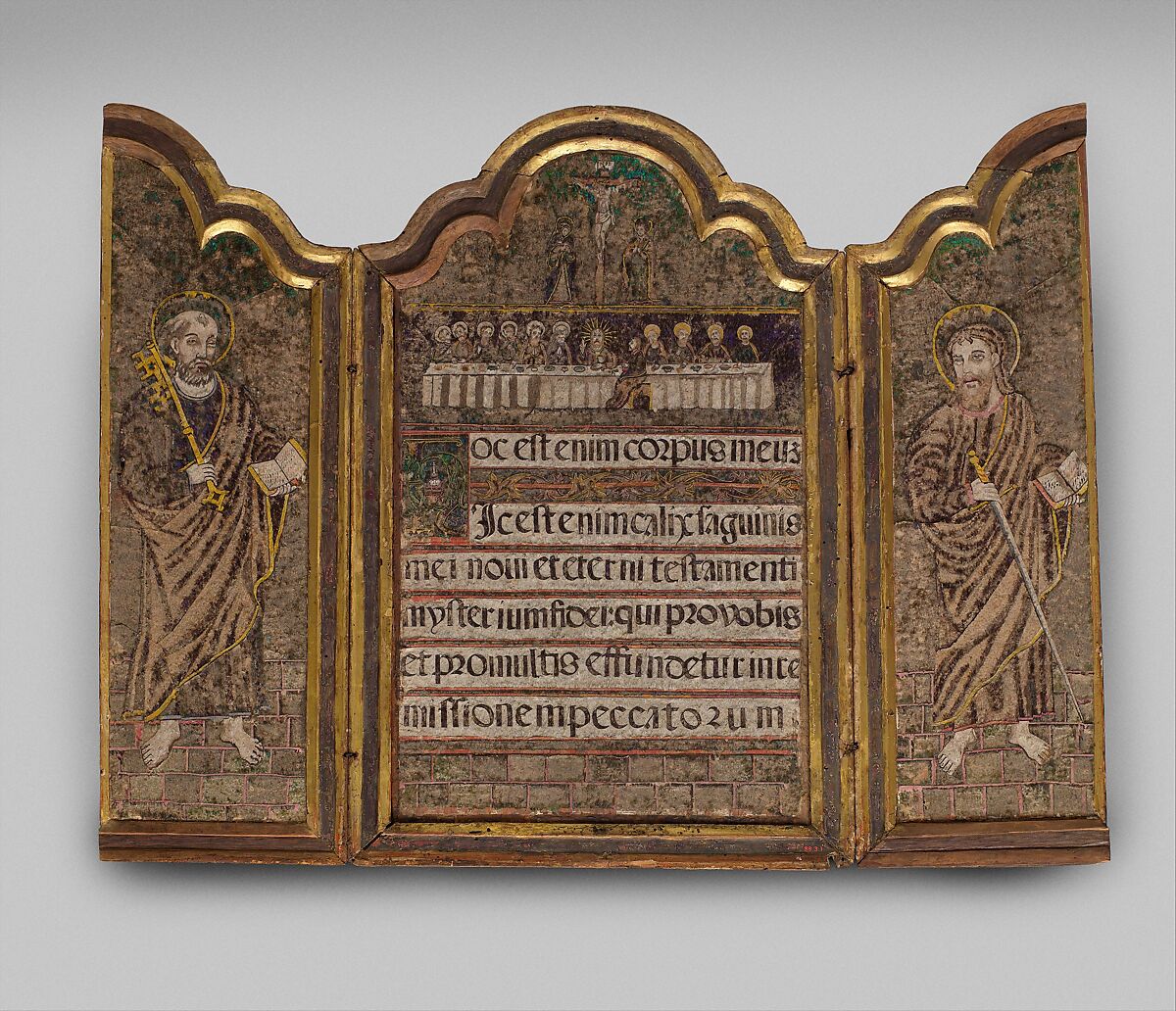
The Met identifies the object as an altar card made by Indigenous featherworkers using a technique that preceded Spanish conquest. A triptych has three panels. The catalog interprets its Christian scene and Latin inscription; those identifications go beyond noticing figures and lettering. Keep visual observation, catalog information and your historical inference separate.
Johanna Hecht’s mission-school study explains that, after conquest, Franciscan schools and workshops redirected Indigenous artistic skills toward Christian uses. This identifies an institutional mechanism within colonial power. Indigenous knowledge and labor remained essential to production. Neither the object nor that institutional account tells us every maker’s belief, consent or interpretation. Do not label Indigenous religion with missionaries’ judgments as though those judgments were neutral descriptions.
Annotate before explaining: On a sketch, mark the central scene, lettering and side panels. Beside it, make three lists: “I can see,” “the catalog identifies,” and “I infer.” Put the material and date in the second list. Put any claim about a maker’s private belief in the third, marked unproven. Write a caption explaining one continuity in technique and one change in religious use.
Check the object annotation
A description of the composition is observable; the material identification and dating depend on the catalog. A supported interpretation connects an established local technique with a Christian function. It cannot turn one surviving work into a census of belief or treat skilled production as proof of free consent. A maker’s testimony, commission or local practice record could address different questions, but none is supplied here.
Trace a different political setting in Japan
The Japanese Association for Renaissance Studies describes Xavier’s arrival in 1549, missionary approaches to local lords, and the Collegio established at Funai in 1581. Its account follows Japanese students’ embassy to Europe and their return in 1590 with printing equipment. Teaching, translation and publication supplied channels through which Christianity could spread. These activities involved Japanese participants as well as European missionaries.
The account also describes successive restrictions, including 1614 and 1639, and the movement of Christian practice underground. Japanese rulers could restrict the mission: this was not the same political relationship as Spanish colonial rule in Mexico. Suppression of public practice does not by itself prove the disappearance of private belief. These selected milestones describe mechanisms and constraints, not a numerical growth curve.
Build two causal chains. For Mexico, connect colonial institutions, workshops, Indigenous skills and a Christian object. For Japan, connect local permission, schools, translation/printing and possible audiences; add a restriction branch. Label a missing-evidence point before either chain reaches “people accepted the teaching.” Do not assign a conversion percentage.
Place 1517, 1549, 1563, 1581, 1590 and 1614 on a timeline. Represent the object’s mid-sixteenth-century date as approximate. Explain why neither Xavier’s arrival nor that approximate object date can be presented as a demonstrated result of the 1563 Trent decree studied above.
Check the expansion comparison
Both cases show institutions and local participants mediating religious communication. Their political settings differ, so similar educational or artistic methods need not have the same outcome. Xavier’s arrival precedes the decree by fourteen years; an approximate date cannot establish a precise causal sequence. A stronger argument explains a mechanism with evidence rather than using chronological overlap as proof of causation.
Transfer: A fictional school prints 200 teaching sheets. A shipping list records 150 delivered; a reader’s letter discusses one. Identify which record establishes production, delivery and reception. Explain why neither 200 nor 150 is a count of converts. Propose one follow-up source and state what it could still fail to reveal.
High school: Submit the annotated sketch, timeline and two chains. AP practice: Write a comparison explaining one shared mechanism and one political difference, using the object and a dated Japanese development. Introductory college: Add an independently sourced local voice or administrative record, documenting translation and context, then revise your argument. These Catholic cases do not complete the history of Protestant expansion, Africa, the Americas or Asia; they supply a focused comparison within that larger history.
Worked example
A comparison can correctly identify criticism of financial abuse in both records while distinguishing the council’s explicit reaffirmation of institutional authority. It cannot conclude that the council adopted Luther’s entire program or that all laypeople changed practice immediately.
Check the reasoning, then transfer it
Loading response history…
Keep your evidence and choose a next step
Loading saved lesson status…