
Ottoman authority: service, insignia and patronage
Investigate recruitment, inspect an imperial insignia and test how patronage could present authority without proving consent.
Your task: Explain how recruitment, insignia and patronage could support imperial authority while distinguishing advancement, authorization, implementation and consent.
Open the investigation · Read the explanation · Your saved evidence
Starting recap and vocabulary
Recruitment brings people into service; promotion changes a position after entry. An official record can document an action without recording the affected person’s wishes. A primary account may argue a position rather than measure a whole population.
- devshirme (devşirme)
- An Ottoman levy used to recruit boys for state service; its operation varied across time and place. This lesson examines a particular archival study rather than a universal rule.
- Janissaries
- An Ottoman infantry corps associated with service to the sultan; recruitment and membership changed over its history.
- qadi
- A judge; the supplied study describes a local judicial office registering a recruitment decree.
- centralization
- Concentration of governing authority or resources at a political center; it does not mean every local action was fully controlled.
Does advancement in imperial service prove that recruitment was voluntary?
Annotate the source cards, draw the recruitment/advancement chain, and classify the four fictional fragments. Write a claim about state capacity that retains coercion and identifies what the records cannot establish.
Classify four records and explain why an appointment is not a consent form. Use source notes to preserve your first interpretation and revision.
Make a provisional claim
Loading saved evidence…
Inspect evidence and test an explanation
The investigation controls appear when your local evidence is ready.
Connect evidence and mechanism
Ottoman service: recruitment, advancement and coercion
Can a system offer advancement to some people while taking away their choice about entering it? Start by separating entry, assignment and promotion. These are different events; evidence for one does not automatically establish the others.
Expansion was a sequence, not a single victory
Before using recruitment or patronage to explain imperial power, locate what that power governed. The Ottoman realm crossed southeastern Europe, western Asia and North Africa. A map of its greatest extent combines developments from different dates; it is not a snapshot of every place at the same earlier moment.
Suzan Yalman’s Metropolitan Museum account, based on work by Linda Komaroff, places Constantinople’s conquest in 1453 and the Mamluk empire’s conquest in 1517. It connects the former with Mehmed II’s rebuilding of the capital and the latter with the incorporation of Syria and Egypt. The account also links expansion to the movement of artists and intellectuals. Military change therefore created questions about institutions and people as well as boundaries.
OpenStax’s Ottoman chapter identifies unsuccessful sieges of Vienna in 1529 and 1683. These are two separate campaigns, 154 years apart. A label saying “Ottoman army at Vienna” cannot by itself mean “Vienna became an Ottoman province.” Use these selected dates to test a claim about uninterrupted expansion; they are not a complete campaign history.
Build a dated regional sketch. Draw three labeled areas: southeastern Europe, Anatolia and the eastern Mediterranean, and northeastern Africa. Place Constantinople/Istanbul beside the connection between Europe and Anatolia; put Syria south of Anatolia and Egypt southwest of Syria. Put Vienna northwest of the Balkan region. This is a schematic locator, not a boundary map or a scale drawing.
Add four event labels: 1453: Constantinople captured, 1517: Mamluk conquest includes Egypt, 1529: Vienna siege unsuccessful, 1683: Vienna siege unsuccessful. Use the words “captured” and “unsuccessful siege,” not color alone. Place the existing 1514 Chaldiran case on the eastern side only if you have studied it; keep that case’s temporary occupation distinct from permanent control.
Then make a second row labeled governing after conquest. Connect rebuilding, appointments, revenue arrangements and patronage to the evidence supplied elsewhere in this lesson or course. A connection is a question to investigate, not proof that every institution changed immediately in 1453 or 1517.
Check the dated regional sketch
The sketch distinguishes regions, dates and event types. Egypt supplies a North African case, Syria an eastern Mediterranean case, and the Vienna campaigns show a limit in Europe. Do not shade the entire Balkans, North Africa or western Asia as conquered at one date. These milestones do not establish all regional boundaries or the status of every province.
An account of capital rebuilding helps connect conquest to consolidation. A recruitment record can explain one institutional practice, but its date and location must match the claim being made. The later Bursa study cannot be silently moved back to 1453. The two unsuccessful sieges also do not prove that every intervening campaign failed or that the empire stopped adapting.
A military mechanism beyond weaponry
In an autobiographical passage reproduced by OpenStax, Sinan describes making a bridge for Süleyman’s army at the River Pruth, followed by promotion to chief architect. The host identifies Howard Crane and Esra Akin’s translation and adaptation from Tezkiretu’l-bunyan. This is retrospective career testimony mediated by an edited excerpt, not a daily engineering log.
Your action: Compare two explanations: “superior weapons made victory inevitable” and “weapons, transport, supply, opponents and political relationships affected what armies could do.” Use the reported crossing to explain one missing mechanism in the first. Name a dated supply account or opposing narrative that could test the second. Distinguish the author’s claim from independent corroboration.
Check the engineering explanation
A river can interrupt an army’s movement even when it possesses effective weapons. Engineering can remove that barrier; a crossing then makes further action possible without guaranteeing success. The account also presents a career achievement, so its retrospective purpose matters. To compare explanations, look for evidence that could challenge them, rather than collecting only examples of successful operations.
Unfamiliar transfer: A fictional dispatch says an army reached a walled city on day 10. Another says a bridge failed on day 12. A tax order names the city on day 15. Classify each as a report or instruction. Write the strongest justified conclusion about control, then identify what would establish entry, occupation and actual collection. None of the three records alone proves all three.
High school: Keep the labeled sketch and explain the difference between capture and siege. AP practice: Compare one expansion event with one constraint, using a dated example and a mechanism. Introductory college: Add a contemporary local record from one named region and assess how it changes the conquest-to-government explanation. A complete Ottoman trajectory still needs fuller provincial variation, North African developments beyond Egypt, frontier settlements and changing institutions through 1750.
Try: classify a career claim
Read the four fictional fragments in the source workbench. They are invented records for reasoning, not translated Ottoman documents. Write a short label for each: an instruction, a recorded selection, a later appointment or an unexplained absence. Then predict which one could challenge the claim that advancement was impossible. Keep your prediction before viewing feedback.
Your task is historical analysis, not reenactment. Explain the institutional mechanism and its human consequences through evidence; do not act out the selection of children or optimize a coercive recruitment system.
Understand the source pair
Busbecq represented Ferdinand I at the court of Sultan Süleyman I. The German Historical Institute introduction places his first journey as ambassador in late 1554 and his return with a negotiated peace in 1562. His account therefore belongs to diplomacy between competing rulers, not an independent modern evaluation of hiring. The later study follows recruitment around Bursa and movement toward the imperial capital, Istanbul.
The Busbecq selection presents an outsider’s argument about Ottoman service. Fordham identifies an 1881 English edition by C. T. Forster and F. H. B. Daniel. The translation, excerpt selection and modern introduction are separate from the sixteenth-century account. The two Busbecq cards are related passages, not independent corroboration.
The Yılmaz study examines a later levy using archival records. Our local cards paraphrase the scholar’s findings; they do not reproduce the Ottoman documents. A historian’s use of a register gives you a route to investigate that record, not permission to claim you personally read it. Keep the study’s 2015 publication date separate from the 1603–04 events.
Do not flatten the time difference into one unchanged institution. The pairing tests how different evidence answers different questions. It does not establish that every detail of a later case applied during the diplomat’s visit. To argue continuity or change, seek comparable records from both periods.
Experiment: follow authority and experience separately
Use the study card to build a simplified institutional sequence. The display below organizes questions; it is not a complete reconstruction of every recruit’s path. Not every recorded selection led to the same assignment or later outcome.
Draw a second line underneath for the person affected. Mark where the supplied evidence concerns that person’s wishes and where it does not. “Not recorded” is different from “consented.” Equally, one report of absence does not establish a person’s destination, motive or final outcome.
| Fictional fragment | What is directly recorded? | What must remain a separate question? |
|---|---|---|
| A: presentation is ordered | A direction by an authority | Was it carried out, and under what constraints? |
| B: a person is listed as selected | Recorded selection | Was the entry accurate, and what happened next? |
| C: a former recruit is appointed | A reported later appointment | How was that person recruited, and how typical was the career? |
| D: someone is marked absent | A report of absence | Why did the person leave, where did they go, and what happened afterward? |
Save your interpretation in the fictional-fragments card. Include one claim the records support and one claim they cannot support. The classification is a starting point; a strong argument explains why the distinction matters.
Test the observer’s argument
Find the comparison in Busbecq’s second card. What would his audience gain from taking the contrast seriously? What evidence would challenge its broad wording? An author’s purpose can explain emphasis without proving the entire account true or false.
Possible advancement and coercive entry are logically compatible. A source describing one does not erase evidence concerning the other. To estimate how common advancement was, you would need a defined group of entrants, follow-up records and a rule for handling people whose outcomes are missing. A collection of exceptional careers cannot supply that denominator.
An administrative mechanism can also serve more than one purpose. Ask whether recruitment could connect officials and soldiers to a central authority, while placing demands on households and local institutions. Support the explanation with the packet and qualify its reach. Describing a mechanism does not justify it or establish that it worked equally everywhere.
Repair three exhibit claims
Write a correction before opening the worked comparison:
- “An outsider praised the system, so the account is either perfectly neutral or useless.”
- “One former recruit reached high office, so every family freely chose recruitment.”
- “A name appears on an absence list, so we know the person’s motive.”
Compare the three exhibit repairs
- Identify the author’s claim, audience and contrast. Use the account as evidence of an interpretation and test its factual reach against independent records. Neither acceptance nor dismissal follows just from the author’s origin.
- Retain the individual appointment, but remove the universal claim about entry. The two propositions address different stages and populations. Seek evidence about recruitment conditions rather than treating later status as retrospective consent.
- Report what the list records and identify missing explanation. A plausible interpretation remains a hypothesis until supported. Do not invent a first-person account for a person whose voice is absent.
These examples support revision. Reading the worked answer does not demonstrate independent proficiency. Record assistance honestly when saving your claim.
Apply: a request linked to an appointment
The unfamiliar check adds a fictional signed request for the same person later appointed. Explain precisely what this adds before checking the answer. It gives evidence about a request, but its circumstances still matter. Consider authorship, pressure, translation and whether the document actually connects to the same person. Do not generalize an individual record to everyone recruited.
Write a short exhibit label that can accommodate both the observer’s account and the later archival study. Include a source citation, a chronology distinction, a mechanism of authority and a limit about experience or outcomes. Preserve your initial interpretation in a note before revising it.
High school: classify the four fragments, repair two exhibit claims and explain the distinction between entry and advancement in your own words.
AP practice: explain a mechanism of imperial administration and analyze the observer’s purpose. Use the later case with an explicit chronology limit. This investigates part of Topic 3.2, not the full unit’s revenue, religious, military and comparative requirements.
Introductory college: inspect a published translation of a decree or register entry and compare it with a scholarly interpretation. State the edition, archival reference when available, selection limits and which document you actually inspected. Add a competing interpretation rather than presenting a bibliography as proof of analysis.
Continue to the course comparison project with this bounded case. A comparison with another empire requires evidence from that empire; the Ottoman account alone cannot supply it.
Making authority visible: insignia and imperial patronage
Recruitment helps explain who serves a ruler. Legitimation concerns claims that a ruler’s authority is rightful. Examine how an emblem and a building complex could communicate those claims. Evidence of a claim is not automatically evidence that an audience accepted it.
Observe before interpreting
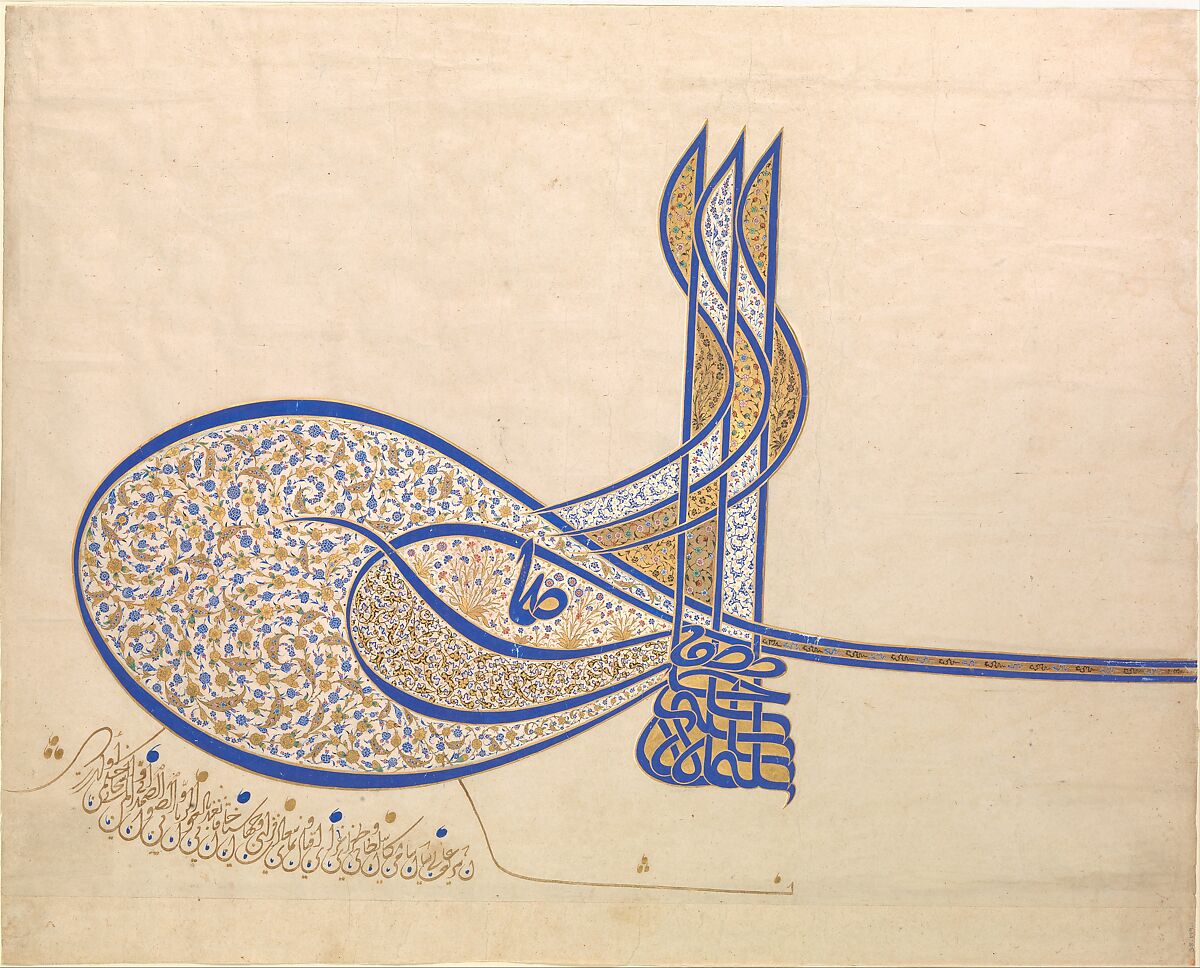
Make three notes using the image or its equivalent description: a visible feature, information supplied by the catalog, and an interpretation you would need to test. For example, visible ornament is different from identifying a named ruler. You do not need to read the script to analyze that distinction.
The Met identifies this tughra, or imperial calligraphic insignia, with Süleiman. Its explanation connects such emblems with decrees and other official media, and distinguishes the artist drawing the emblem from the illuminator decorating it. Its reading includes the ruler’s identity, ancestry and a claim of enduring victory. The image is a primary material source; those identifications are modern curatorial interpretation. A digital reproduction cannot independently establish the material as gold or the date.
Repair this proposed label: “Süleiman personally drew this signature, proving that everyone obeyed his commands and that he never lost a battle.” Replace it with 50–80 words explaining the emblem’s possible role in authorization and royal presentation. Attribute your information. Name one conclusion that the object cannot support.
Check the insignia label
A defensible label identifies the object using the museum catalog, describes visible decoration and explains how a recognizable emblem could associate a document with royal authority. Specialized production matters: an official emblem need not be the ruler’s personal handwriting. A victory formula is a political claim, not a complete record of military outcomes.
The image does not show every recipient, a particular command being executed or everyone’s beliefs. To test a specific administrative effect, seek the associated document, its provenance, recipients and subsequent records. Do not invent the missing text of a decree around this image. Acknowledging these limits does not make the object useless: presentation and authorization are historical questions in their own right.
Connect a monument with institutions
Move from an object associated with Süleiman to a different commission. UNESCO attributes the Selimiye complex in Edirne to Selim II, with Sinan as architect. Keep these names distinct. Its account describes a mosque with a central dome and four minarets, educational institutions, a library and a covered market. A külliye is a group of buildings organized around a mosque and managed together. This modern heritage description supplies institutional context, not a sixteenth-century visitor survey. UNESCO’s account of Selimiye is the source for these facts; no local photograph or original endowment deed is supplied here.
Draw a relationship diagram, not a floor plan:
Change one link: suppose a school building survives but its operating records do not. Which claims remain possible, and which become uncertain? Now suppose a dated attendance list is found. What does that add, and what still cannot be inferred about political loyalty?
Create an evidence plan with three rows:
| Question | Record or observation to seek | Limit to preserve |
|---|---|---|
| Who supported construction? | Commission, expenditure accounts, inscriptions and provenance | A commission does not by itself prove payment or completion |
| Did an institution operate? | Dated staffing, maintenance or attendance records | One period does not establish uninterrupted operation |
| How did people respond? | Attributed visitor accounts, petitions or other responses | A selected voice does not represent the whole population |
Religious practice, learning, commerce and political representation can overlap. Do not reduce worshippers to a single political motive or assume that service use proves agreement with the patron. Architectural visibility could help associate a dynasty with religious and civic provision; that is a mechanism to investigate through evidence of production, operation and reception.
Check patronage and reception
A surviving building can support investigation of design and material form. The heritage description identifies institutional functions, but it does not supply a complete operating history. A dated attendance list would add evidence of recorded attendance in that setting and period. It would not establish why everyone attended, whether they approved of the ruler, or how nonparticipants responded.
The mechanism has several possible points of failure: a commission might not be fulfilled, an institution might lack resources, and audiences might interpret a patron differently. These are possibilities to test, not claims that they occurred at Selimiye. Do not draw a numerical popularity score from building size or ornament.
Compare two ways of presenting authority
Prepare an exhibit with two panels: insignia and official communication; patronage and institutional space. Give each an attributed source, a possible mechanism and a missing kind of evidence. Distinguish Süleiman from Selim II and the primary object from modern catalog and heritage descriptions. Explain one similarity and one difference without claiming the same audiences encountered both in the same way.
Then transfer the method to this invented archive, unrelated to Ottoman events: a council orders a library in year 1; accounts record completion in year 3; one resident praises it in year 4; another petitions about restricted access in year 5. Write two sentences revising “the order proves universal support.” Identify which new record concerns construction and which concern reception. The records are stipulated authentic for this reasoning exercise only.
Check the unfamiliar patronage archive
The order establishes an intention; the completion account adds evidence about implementation. The praise and petition provide different attributed responses at different dates. They challenge an unsupported claim of universal approval but do not establish what proportion of residents held either view. A stronger answer requests access rules, additional independently situated responses and evidence about who could use the institution.
A useful comparison explains how an emblem could mark authorization while a complex could associate a patron with visible institutions. Neither mechanism automatically establishes compliance or consent. Reading this feedback is guided practice, not an independent assessment of your historical argument.
High school: submit the observation notes, repaired label and institution diagram. AP practice: explain an art or architecture mechanism of legitimation and compare it with recruitment as a mechanism of administration; support each with different evidence. Introductory college: trace an actual endowment, account or reception text through a reliable edition, then revise the exhibit using it. Record what you inspected and what is still known only through secondary description. Broader imperial legitimation and independent review remain further work.
Worked example
Fictional fragment C establishes a reported appointment for one former recruit. It can challenge the claim that advancement was impossible. It does not establish that every recruit advanced, that recruitment was voluntary, or that the appointment reflected ability alone. A reasoned account retains both the individual possibility and the missing population evidence.
Check the reasoning, then transfer it
Loading response history…
Keep your evidence and choose a next step
Loading saved lesson status…