
Sultanates, coinage and cultural authority in South Asia
Use coins and buildings to distinguish a ruler's public claims from actual control and religious uniformity.
Your task: Use coins and buildings to distinguish a ruler's public claims from actual control and religious uniformity.
Open the investigation · Read the explanation · Your saved evidence
Starting recap and vocabulary
A political boundary does not imply that every resident shares the ruler's language, religion or interests.
- numismatics
- The study of coins and related monetary objects.
- Persianate
- Participating in cultural traditions shaped by Persian language and literature, without implying one ethnicity or state.
What can a coin establish about a ruler's power?
Make an object evidence card with inscription, material, date, find context and possible routes of circulation. Unfamiliar written task: a new coin with an imperial title is found far beyond a mapped border. Write two competing explanations and a 250-word plan identifying the archaeological or textual evidence that would discriminate between them. Include one claim the coin cannot support.
Separate observation from inference on an object card.
Make a provisional claim
Loading saved evidence…
Inspect evidence and test an explanation
The investigation controls appear when your local evidence is ready.
Connect evidence and mechanism
Sultanates, coinage and cultural authority in South Asia
What can a coin establish about a ruler’s power?
Context and mechanism
The Delhi Sultanate began in the early thirteenth century and included successive dynasties ruling changing territories. Military conquest, administrative practice and regional negotiation all shaped authority. North India was not a culturally uniform space, and southern and regional states followed their own trajectories. Use a dated map rather than projecting the greatest extent of a dynasty across three centuries.
Persianate court culture and Islamic political traditions influenced elite institutions, while local languages, established social structures and diverse religious communities remained important. Cultural exchange could occur alongside conflict and unequal power. Neither a story of total replacement nor a story of frictionless blending explains every locality. Identify who commissioned a work, who produced it, what materials and conventions they used, and how different audiences might encounter it.
Coinage offers a compact claim to authority. A ruler’s title and mint name associate a portable object with a political center; standardized units can support taxation and commerce. Yet circulation is not identical to direct sovereignty. Coins may travel through trade, tribute, military payments or later collecting. Archaeological context, wear, composition and date help distinguish these pathways. A ruler’s ambitious title states a claim, not the verified boundaries of an empire.
Monumental architecture likewise requires several readings. A building can organize worship, display patronage and make power visible. Reused materials may reflect conquest, availability or specific political choices; interpretation requires site-specific evidence. Do not infer that every resident converted from the existence of a mosque, or that one commission represents all relations among communities. Material evidence survives unevenly and disproportionately records powerful patrons.
South Asian cases connect to broader Islamic worlds through scholars, merchants, migrants and artistic conventions, but ‘Dar al-Islam’ is not a single state. Political fragmentation and cultural connections could coexist. To compare Delhi with another region, hold the mechanism steady—coinage, scholarly patronage or administration—and then investigate differences. This unit develops a South Asian material-source method; it does not replace a full study of the Abbasid legacy, Mamluks, Sufism or Southeast Asia.
Work through the evidence
A fictional excavation contains 12 coins naming ruler R, 3 naming a predecessor and one coin from a distant mint. You can count the assemblage and identify claims on the coins. You cannot infer that 75% of local people supported R or that the distant ruler governed the site. The deposit date, whether it is a hoard, and the coins’ production dates determine which historical questions the assemblage can answer.
Your investigation
Make an object evidence card with inscription, material, date, find context and possible routes of circulation. Unfamiliar written task: a new coin with an imperial title is found far beyond a mapped border. Write two competing explanations and a 250-word plan identifying the archaeological or textual evidence that would discriminate between them. Include one claim the coin cannot support.
Sources and their limits
Medieval Indian coinage
The museum describes Delhi Sultanate attempts at monetary standardization, coin denominations and the use of rulers’ titles.
Institutional account of material evidence, paraphrased. Consult individual coin images and provenances before interpreting a specific object.
Consult the source collection or original. Original LearnAI teaching text; not a quotation. External originals retain their own rights.
South Asia: North, 1000–1400
The chronology situates the beginning of the Delhi Sultanate around 1206 and relates successive rulers to regional artistic and architectural production.
Secondary museum chronology. It supplies dates and context, not a population survey of belief or political loyalty.
Consult the source collection or original. Original LearnAI teaching text; not a quotation. External originals retain their own rights.
Excavated coin group
12 coins of R, 3 of a predecessor and 1 from a distant mint; deposit context unknown.
Invented assemblage. Missing provenance is intentional; no archaeological discovery is claimed.
Extend and revise
High school: Separate observation from inference on an object card.
AP practice: Connect state formation, belief and cultural production while comparing regional institutions.
Introductory college: Analyze an actual cataloged coin or monument using provenance, material description and two scholarly interpretations.
Which part of your argument describes an observable object, and which reconstructs a possible history?
Scientific knowledge: object, instruction and certification
A coin can communicate a claim to political authority. A scientific instrument raises another question: how are skilled making, teaching and the authority to certify knowledge connected? This case moves from Delhi to Yemen. Keep the places separate; a shared connection to Islamic intellectual traditions does not make them one state or one workshop.
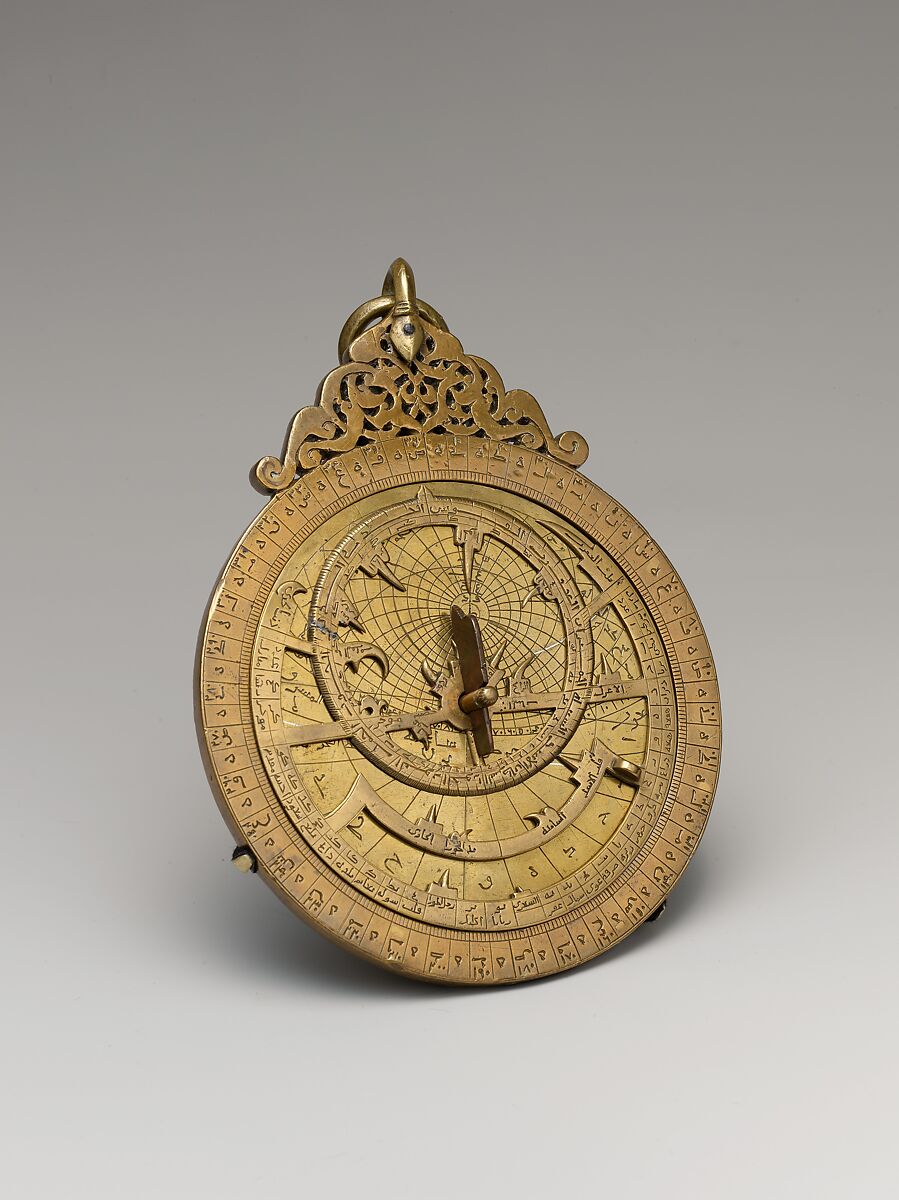
Observe before interpreting
Draw three columns: visible feature, catalogue information, question still open. Place the circular scales and central framework in the first column. Place the maker, date and location in the second. Put a claim about how often the instrument was used in the third. You can complete the observation task using the image description if you cannot see the photograph.
The Met’s object record connects the instrument’s inscription with a Rasulid prince who later ruled in 1295–96. It reports that a manuscript preserved in Cairo describes this piece and includes teachers’ certifications of his competence as a maker. This lesson supplies the museum’s interpretation, not a transcription of that manuscript. Learners have not inspected its wording merely by reading this summary.
An astrolabe relates celestial observations to an engraved representation used for calculation. The museum discusses astronomical and religious uses, including time and prayer-related questions. This is an object-history investigation, not an operating manual or a working replica. A photograph alone cannot validate the instrument’s calibration, establish a particular observation or reproduce its user’s procedure.
Build an evidence chain
Arrange four cards on paper or in your notes:
- A surviving instrument and its markings.
- A reported manuscript description of the instrument.
- Reported teacher certifications in that manuscript.
- The modern museum’s interpretation connecting these records.
Draw arrows showing which connection you can inspect here and which depends on the catalogue’s report. The photograph gives direct visual access to one view of an object. The museum supplies context and relationships; it does not turn the unseen manuscript into a locally available primary text. Two webpages repeating this same catalogue are not two independent manuscript witnesses.
Now annotate a second chain: learning → making → certification → circulation → use → effects. Mark the steps for which the supplied information offers evidence. Leave other steps open. A certification could help investigate recognition of a maker’s skill; it does not by itself establish how many people learned from the work or what social outcomes followed.
Repair an argument
An exhibition draft says: “Because this prince made an instrument in 1291, he invented astronomy and everyone in his realm could use it accurately.” Write a 150-word correction. Include a dated, attributed positive claim rather than simply declaring that nothing can be known. Then identify the different records needed to investigate invention, access, use and accuracy.
Compare the instrument argument
The object and catalogue support a bounded investigation of a particular maker, a dated instrument and reported links to instruction and certification. They do not establish priority over all earlier makers. Nor do they supply a population survey, observation log or performance test. A stronger account distinguishes a documented instance of skilled production from universal access or demonstrated social effects. Its next sources might include an earlier treatise, a dated teaching record, an owner’s account and a reconstruction with explicit limitations; each would answer a different question.
Test transmission with changed evidence
In a fictional archive, a catalogue names an instrument manual but provides no surviving copy. A later manuscript contains a similar diagram, and its owner notes practising with an instrument. Distinguish evidence for a reported title, surviving content and a reported use. Explain why similarity alone cannot identify the direction of borrowing or prove a direct teacher–student relationship.
If a dated translation explicitly identifies its source, what would that add? It would support a more specific transmission claim, subject to checking attribution and chronology. It would still not prove that every reader understood or adopted the method. The hypothetical archive is practice, not a newly discovered history of this Yemeni object.
High school: submit the three-column observation card and one repaired claim. AP practice: explain how production, teaching and certification could support intellectual activity, identifying both the supplied evidence and the missing evidence of wider effects. Introductory college: locate a scholarly edition or catalogue of the reported manuscript, record whether you inspected it, and compare its claims with the museum summary.
Return to the coin investigation: an inscription, an administrative outcome and a later interpretation are different evidence. This scientific case adds a dated starting point. Further intellectual traditions, actual translated passages, wider circulation and assessed independent explanations remain open course requirements.
Reading a teaching text: audience and translation
Place 1291: Yemeni instrument and c.1391: Chaucer’s instructional text on two separate timeline cards. The dates are about a century apart. They permit comparison; they do not establish a direct route from this particular object or its maker to Chaucer.
The preface to Geoffrey Chaucer’s Treatise on the Astrolabe, presented in Middle English by Fordham’s Internet Medieval Sourcebook, addresses a learner called Lowys. Its argument for English includes this phrase:
“for Latyn ne canst thou yit but small”
Reading help: the author says the learner knows little Latin. This gloss explains the phrase; it is not a quotation from a modern translation. In the same preface Chaucer identifies himself as a compiler and discusses teaching in Greek, Arabic, Hebrew and Latin. He presents English instruction as another way of communicating knowledge. The passage supplies an author’s stated purpose and account of his work, not a measured history of every translation or reader.
The IET Archives description documents a manuscript containing Chaucer’s text alongside a Latin work on the magnet. That surviving witness is a different kind of evidence from the preface’s instructional claims. We use the archive’s description here, not a claim to have collated its manuscript against Fordham’s text. The identity of the addressed learner need not be settled to analyze the stated audience; do not turn a debated biographical identification into a premise of the exercise.
Annotate purpose, access and evidence
Make four annotations, each naming a specific piece of evidence:
- Audience: which language barrier does the quoted phrase identify?
- Choice: how might writing in another language change who could learn?
- Limit: what additional resources, skills or opportunities might a learner still need?
- Outcome: what record would distinguish the author’s intention from a reader’s successful use?
Draw this chain with an open question beneath every arrow:
Earlier knowledge → compilation or translation → instructional text → reader’s practice → demonstrated result.
The chain is a research framework, not a reconstructed itinerary. The preface informs some links; it does not identify all intermediaries or prove the final result. Do not draw an arrow directly from ‘Umar’s 1291 instrument to Chaucer merely to fill a gap.
Compare the two cases
Write two paragraphs explaining how the cases make knowledge and authority visible. In the first, use the museum’s report of making and certification, with its mediation stated. In the second, use the quoted preface and the archive’s description to discuss audience and textual survival. End with one question that neither case resolves.
Review the teaching-text comparison
A defensible comparison can contrast certification of a maker with a writer’s effort to explain procedures to a learner. The supplied phrase supports a language-access claim. It does not prove universal literacy, access to an instrument or successful observations. The catalogue and archive description establish bounded source relationships; they do not supply a direct connection between the Yemeni instrument and the English text. Other comparisons are valid when they attribute evidence accurately and avoid converting intention or survival into universal use.
Revise after an unfamiliar discovery
In a fictional exercise, you first have only a preface promising plain-language instruction. Then you receive a dated reader’s note reporting a failed attempt, followed by a correction. Write one sentence that becomes better supported and one claim that remains unsupported. A reported attempt adds evidence of engagement; it does not invalidate the stated teaching purpose or establish that every reader failed. The correction gives a new question about learning and revision, not automatic proof of eventual success.
High school: annotate the phrase, explain the two timeline cards and repair one unsupported arrow. AP practice: use both cases to explain an intellectual exchange mechanism while separating authorial purpose, surviving evidence and effects. Introductory college: compare a specific preface passage across a scholarly edition and a catalogued manuscript witness, documenting what was actually accessible and any textual variation.
This comparison supplies a short primary-text window into instructional adaptation. It does not replace the missing Yemeni manuscript, establish all transmission routes or complete the wider history of intellectual innovation.
Worked example
A fictional excavation contains 12 coins naming ruler R, 3 naming a predecessor and one coin from a distant mint. You can count the assemblage and identify claims on the coins. You cannot infer that 75% of local people supported R or that the distant ruler governed the site. The deposit date, whether it is a hoard, and the coins' production dates determine which historical questions the assemblage can answer.
Check the reasoning, then transfer it
Loading response history…
Keep your evidence and choose a next step
Loading saved lesson status…