

Print, representation and civic culture: who speaks, pays and responds?
Compare represented voices, patrons, surviving objects and documented cultural uptake without inventing reception.
Your task: Compare represented voices, patrons, surviving objects and documented cultural uptake without inventing reception.
Open the investigation · Read the explanation · Your saved evidence
Starting recap and vocabulary
Separate a historical record, a proposed mechanism and a demonstrated outcome.
- Coverage
- The places, people, events or objects a record includes.
- Reception
- A documented response or uptake, distinct from mere availability.
Can a fictional visitor or a later score copy establish an audience’s beliefs?
Compare two new cultural witnesses and one credited source; identify continuity and change, a documented uptake and an alternative reading.
Complete the private supplied comparison with a dated source and one explicit limit.
Make a provisional claim
Loading saved evidence…
Inspect evidence and test an explanation
The investigation controls appear when your local evidence is ready.
Connect evidence and mechanism
Print, representation and civic culture: who speaks, pays and responds?
A fictional visitor criticizes a noble; a royal ceremony has a commissioned score; an ancient scene hangs before eighteenth-century viewers. Each is evidence about culture, but not in the same way. Distinguish author, represented speaker, patron, audience and documented response. No one must disclose political or religious beliefs, perform music, or impersonate a represented community.
A Persian speaker is not a Persian field report
Montesquieu’s Persian Letters first appeared in 1721. The GMU/CUNY historical source collection supplies Letter LXXIV through a 1736 London third edition, pages 157–158, with no translator identified. This is the inspected English witness, not a newly verified 1721 manuscript or exact original French wording.
In the excerpt, Usbek recounts a visit to a French noble. He contrasts the noble’s arrogant gestures with his own account of how a person of rank should treat visitors and act in public ceremonies. This exposes the difference between inherited status and behavior. But Usbek still describes a hierarchy; the passage is not a program of equal citizenship. Montesquieu, himself a French noble, created this speaker. Usbek is not an independently interviewed Persian observer, and his description cannot stand in for the views or practices of people in Iran.
Source action. Mark three layers: the French author’s construction, the fictional speaker’s criticism and the modern editor’s selected English witness. Explain how an imagined external perspective can challenge a European norm without becoming reliable ethnography. An interpretation that treats criticism as proof that the author escaped all assumptions about hierarchy is too simple.
Philip Stewart’s scholarly edition history identifies the 1721 imprint’s supposed Cologne publisher as a cover for the Amsterdam Desbordes house directed by Susanne de Caux. A second, altered edition followed that year. Later imitations, including Graffigny’s Letters of a Peruvian Woman in 1747, document literary uptake. They do not count every reader or establish assent. The 1758 revision also differs from the first edition: numbering and wording must be checked before combining passages.
Print makes a claim available; reception needs another witness
Censorship and commercial publication did not divide neatly into a world with discussion and a world without it. Concealed publication, circulation and adaptation could extend argument beyond its first setting, while cost, literacy and access still limited participation. The credited R05 inquiry into Geoffrin’s reported transmission of Voltaire distinguishes delivery, reported response and legal outcome. Keep that distinction here rather than inventing a circulation total.
A claim about an enlarging literate public requires evidence beyond the existence of a book. Surviving editions and imitations establish particular forms of uptake; reading records can establish a situated encounter; a legal change requires its own witness. None alone measures all-European opinion. Even a favorable response may address literary style rather than the political conclusion a later historian hopes to find.
Fictional transfer. An advertisement says “third edition.” A learner concludes that three times as many distinct readers endorsed the work. What is missing? Edition size, overlap among buyers, actual reading and response are separate unknowns. The inference fails even if the advertisement accurately describes the edition.
Religious and royal music: inspect the witness, not an imagined performance
The patronage investigation already supplies a royal and religious visual comparison, including Rubens. Baroque artistic forms continued to serve such settings into the eighteenth century; private subjects did not instantly replace royal or religious commissions around 1750.
The Harry Ransom Center’s manuscript account identifies a complete score of Handel’s coronation anthems copied circa 1730 by John Christopher Smith the Elder. The works were composed for George II and Queen Caroline’s 1727 coronation. The institution also distinguishes the coronation sequence from a later customary sequence. This is catalog and conservation testimony about a surviving score, not our inspection of the 1727 event or a claim that a recording has been heard.
The commission joins royal authority with a religious ceremony. That contextual relationship is available without inventing sonic observations such as “every listener felt awe.” A score’s date, copyist and use can be analyzed independently of an optional performance. If a later copy changes the ordering, revise the claim about sequence rather than calling the whole work inauthentic.
Domestic subjects and civic questions can coexist
The Met’s Chardin exhibition interpretation describes small domestic scenes and children’s activities circulating through engravings. This gives a concrete bourgeois/private-life strand alongside inherited royal commissions. It does not mean every domestic scene had a middle-class buyer or that royal patrons stopped buying art. Subject, purchaser and audience must be established separately.
Now inspect a different cultural use of an earlier world: Jacques Louis David, The Death of Socrates, 1787, Met object 31.45. The museum’s catalog and public-domain image identify a Neoclassical composition and explain that Plato is deliberately included although he was not present at Socrates’s death. This is an eighteenth-century representation of antiquity, not an eyewitness image of ancient Athens.
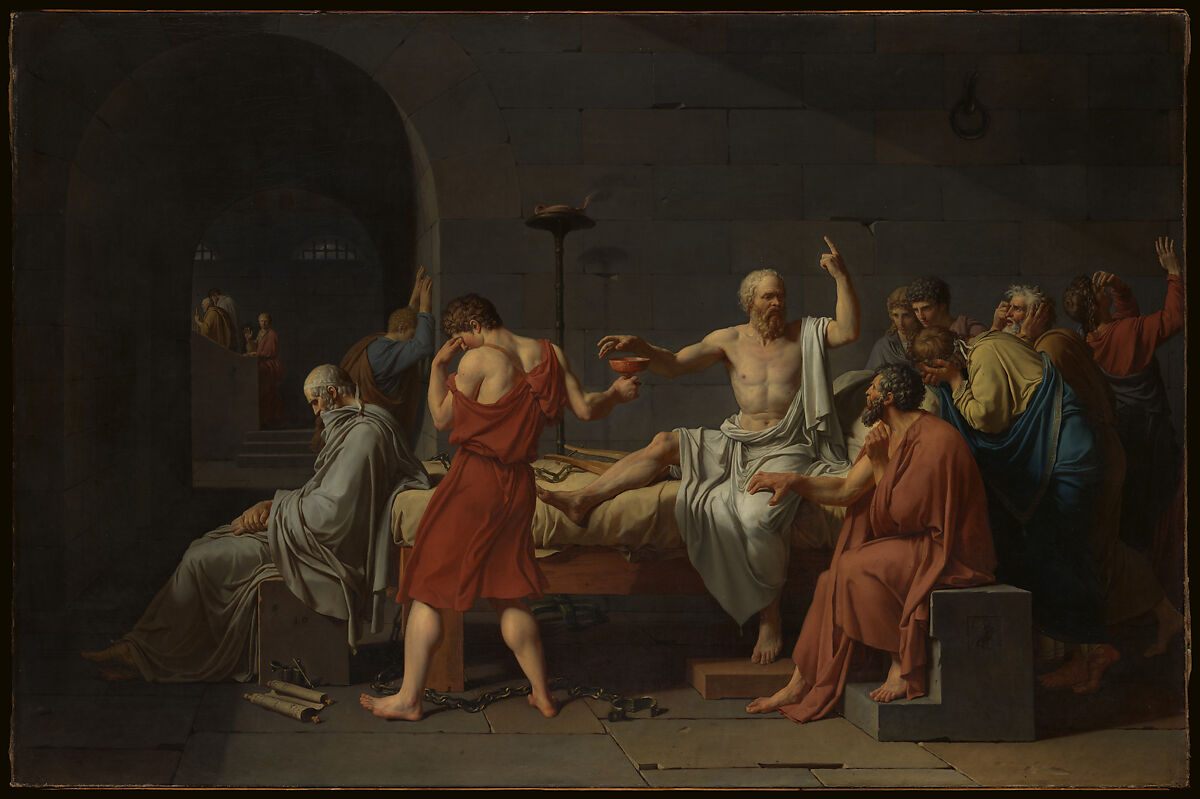
Original accessible equivalent from the inspected image: Figures occupy a shallow horizontal space. The central, upright figure gestures upward; several companions lower their heads or turn away. An older seated figure is isolated at the left end. Stone blocks and a limited palette contrast with the bodies’ gestures. The composition directs attention to a deliberate choice and its witnesses rather than to a crowded royal spectacle.
Look, infer, qualify. Identify one visible feature and explain how it could invite reflection on conviction and civic authority. Label that explanation as an interpretation. Neither the subject nor the year proves that all viewers favored revolution. A civic moral example can be discussed before a revolution, under monarchy, or by audiences who disagree about its implications.
Compare the evidence chain
| Cultural witness | Established source condition | Question that needs separate evidence |
|---|---|---|
| Selected Persian Letters excerpt | Fictional criticism through a specified later English edition | What did actual readers believe or do? |
| Coronation score account | Royal/religious commission; later surviving copy | How did a particular listener respond? |
| Domestic genre and engravings | A documented subject and circulation form | Who purchased, saw or used a particular work? |
| David’s painting | An inspected 1787 interpretation of antiquity | How did contemporary audiences connect it with civic life? |
Private task. Construct a comparison using two of these witnesses and one credited earlier source. Explain a continuity in patronage or authority and a change in subject, circulation or audience. Include one documented response or uptake where supplied, rather than equating availability with belief. Give an alternative interpretation of the same visible or textual feature.
Worked interpretation. Usbek’s criticism demonstrates a literary challenge to noble behavior, but its remaining hierarchy complicates an egalitarian reading. The score documents another use of culture in a royal-religious setting. David’s retrospective composition opens a civic question without recording what ancient or eighteenth-century audiences unanimously thought. These differences support plural, overlapping cultural uses rather than a single replacement sequence.
Changed condition. A catalogue correction identifies an alleged contemporary audience response as a nineteenth-century retrospective judgment. Which part of your argument changes? Keep the artwork’s date if unchanged, but withdraw the claim about contemporary reception. Later memory remains evidence for a different question.
Compare after retaining your first interpretation
The correction removes one link, not every link. The painting remains a dated object, the later judgment remains a dated act of interpretation, and the connection between them must be described honestly. Treating the response as contemporary would backdate evidence. Treating all interpretation as useless would discard what later reception can establish. Likewise, the fictional Persian voice can expose European assumptions without functioning as a community’s own testimony.
For an independent extension, choose one public catalog or attributed textual witness, justify its genre and date, and defend two plausible interpretations. Do not invent an unobserved performance, redistribute restricted images, or collect personal beliefs.
Worked example
A third edition establishes a particular edition claim, not three times as many distinct readers or assenting citizens.
Check the reasoning, then transfer it
Loading response history…
Keep your evidence and choose a next step
Loading saved lesson status…
What will you take away?
Keep a private reminder for yourself.
Open your existing lesson notes and evidence.
Loading your journal…