

Renaissance art: patronage, perspective and lived worlds
Compare classical forms, geometric perspective, religious naturalism and everyday subjects through patronage and cross-regional exchange.
Your task: Compare classical forms, geometric perspective, religious naturalism and everyday subjects through patronage and cross-regional exchange.
Open the investigation · Read the explanation · Your saved evidence
Starting recap and vocabulary
Separate the historical object, its edition or record, and the interpretation you make from it.
- Naturalism
- A representational approach making bodies, materials or space convincing; not a guarantee of unfiltered documentation.
Whose world does a convincing image represent?
Analyze the original perspective model and dated artwork records, then independently correct an unfamiliar catalogue’s claims.
Make a dated evidence table or prose chain and explain one limit.
Make a provisional claim
Loading saved evidence…
Inspect evidence and test an explanation
The investigation controls appear when your local evidence is ready.
Connect evidence and mechanism
Renaissance art: patronage, perspective and lived worlds
An image can look convincing without documenting an event exactly as it happened. Ask three different questions: what is represented, how is it constructed, and who commissioned or encountered it? Italian and Northern Renaissance art provide comparisons, not sealed cultures with one style each.
Papal patronage and classical learning
Raphael’s School of Athens belongs to the Vatican Room of the Segnatura’s decorative program of 1508–1511. The room served Julius II as a library and private office. Ancient philosophy appears alongside theology, law and poetry in the room’s broader program. Classical learning in a papal setting is not evidence that the patron abandoned Christianity. Vatican Museums: room, function and dates; Uffizi: Julius II’s commission and completion of the first room in 1511.
View the work at the official Vatican collection page. Text alternative: groups of robed thinkers stand, write and discuss beneath monumental arches and a recessed, coffered vault. Two central figures occupy the opening along the main architectural axis; steps and floor patterns organize the foreground. The museum identifies Plato and Aristotle at the center and interprets other figures through attributes and gestures. The represented gathering is an imaginative assembly of thinkers, not a photograph of one meeting.
Rounded arches, massive architectural forms and antique figures connect the image to classical models. Geometric perspective organizes a believable depth: lines representing parallel edges recede toward a common region, while repeated forms and changing apparent size support spatial coherence. Naturalism concerns convincing representation of bodies, materials or space; it does not mean every detail is an unmediated copy of nature. A painter can combine naturalistic figures with an imagined setting.
Papal and princely patrons used prestigious architecture and art to associate rule with learning, magnificence and inherited authority. A commission demonstrates resources and intended display; whether it increased obedience or admiration requires reception evidence. Viewers were not automatically the whole population. A private office and a publicly accessible church offered different encounters.
A perspective model, not a tracing of Raphael
Try: explain why making the convergence point higher would change the implied viewpoint. Use a prose explanation instead of drawing if preferred. Then name one inference about a patron that the diagram cannot establish.
Worked visual reasoning
Changing the horizon changes the viewer’s implied eye level in the constructed scene. Convergence is evidence of a representational choice, not proof that all historical viewers stood in one place. Neither the geometry nor the presence of classical figures establishes who paid for the work, who could see it or what they believed. Those require commission, placement and reception records. The artwork and the archive answer connected but different questions.
Northern religious naturalism and cross-regional exchange
Gerard David’s Annunciation, 1506, represents a sacred event through detailed figures, drapery, floor tiles and domestic furnishings. An angel gestures toward Mary; a book rests on a stand, and a vessel holds flowers. The figures occupy interiors made materially recognizable to viewers. Here familiar objects and human-centered representation serve religious meaning, rather than displacing it.
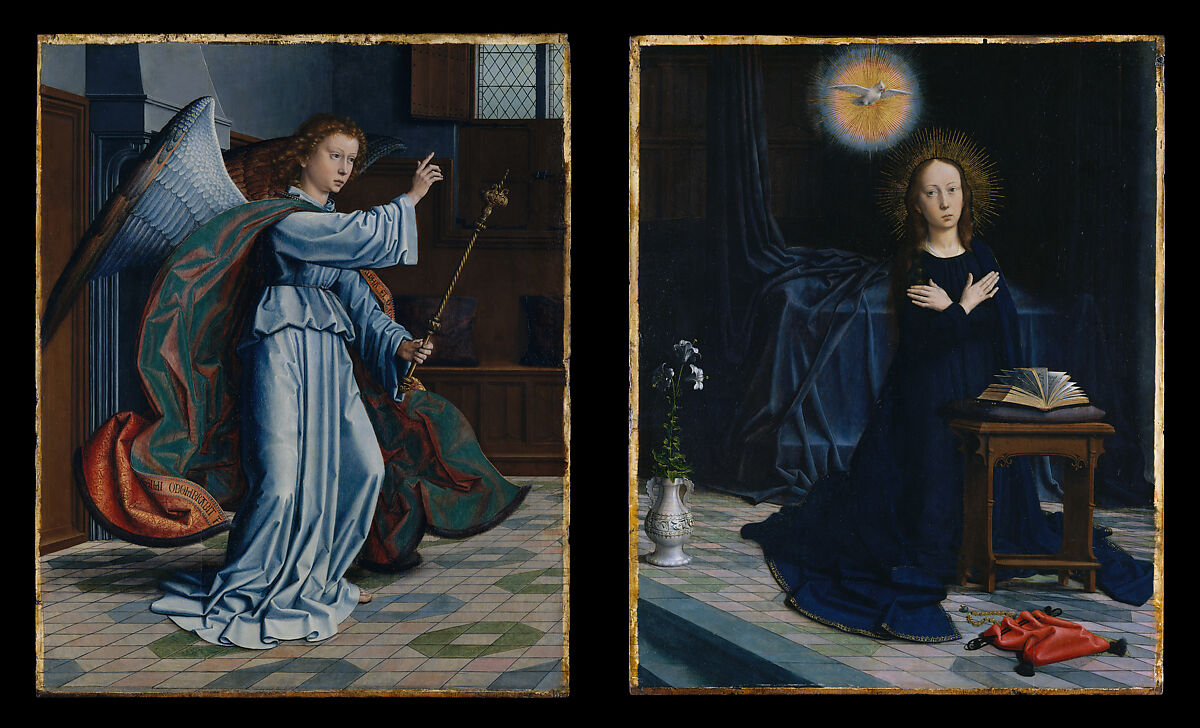
The Met’s object record identifies an important complication: the Netherlandish painter’s panels belonged to an altarpiece commissioned by the Italian banker and diplomat Vincenzo Sauli for a Benedictine abbey near Genoa. Their scale and perspective accommodated viewing from below. The record interprets the ensemble as combining Northern and Italian modes. Region of production, patron’s connections and destination are separate variables; cultural transmission did not stop at a modern national border.
Do not convert the classroom contrast “Italian classical models/Northern religious naturalism” into a universal rule. Raphael worked for a pope; David’s work traveled through an Italian patron. A comparison should explain an emphasis while testing exceptions.
Ordinary life is a subject, not an unfiltered social survey
Pieter Bruegel the Elder’s The Harvesters, 1565, makes rural work and rest the central subjects. In the foreground some figures eat or rest beneath a tree while others gather or cut grain; cultivated land recedes toward a settlement and water. The individual poses, tools, food and landscape make everyday life worthy of close representation.
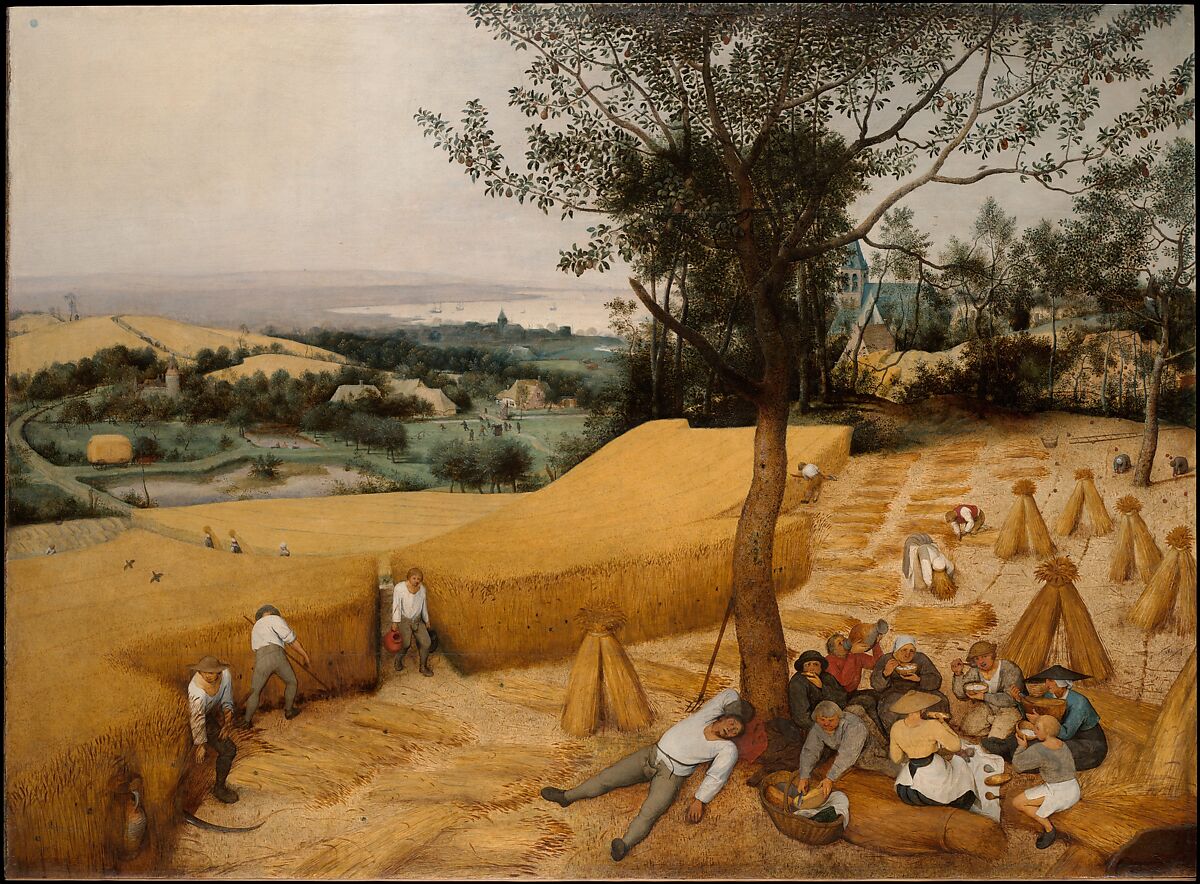
The Met’s record dates the work and identifies it as part of a seasonal cycle commissioned by an Antwerp merchant for his country house. That setting matters: an image of laborers is not necessarily an image made for laborers. It cannot supply a wage series, total harvest or representative account of every worker’s experience.
The picture permits an argument about choices of subject, space and audience. To evaluate working conditions, pair it with contracts, accounts or contextualized testimony. Do not infer that visibly resting figures establish universal leisure or prosperity. Likewise, a wealthy patron’s preferences are a possible influence, not proof that every depicted object is false.
Independent transfer: the catalogue and the room
Use these invented records. An artist trained in a northern city paints a religious scene for a southern city’s merchant. The contract specifies a chapel display and the patron’s emblem. The image contains an arched interior and a detailed workbench. A catalogue says, “Northern origin proves that classical forms are absent, and detailed objects prove an exact record of ordinary life.”
Before reviewing, write a private 180–230-word correction. Use two dated works above, separating visual observation from commission context. Explain one reason the patron’s emblem matters and one claim it cannot establish. Name a record that could test actual audience or reception.
Original model with criterion annotations
Training location alone does not determine every visual choice. David’s 1506 panels connect Netherlandish production with an Italian patron and destination; classical forms and religious subject matter also coexist in Raphael’s Vatican program of 1508–1511. The invented catalogue turns a useful regional comparison into an absolute rule. The arched space needs visual analysis, not classification by birthplace alone.
Detailed objects can make a scene recognizable while serving composition or symbolism. Bruegel’s 1565 workers are represented in a painting commissioned for a merchant, not recorded in a labor survey. The invented emblem can support the patron’s intended association with the chapel work, but it does not measure viewers’ admiration. Chapel access records, descriptions of ceremonies or dated visitor accounts could help test audience and reception.
Observation: name visible features without inventing measurements. Context: separate maker, patron and display location. Comparison: use dated examples and recognize exchange. Inference: do not turn realism into exact documentation or an emblem into measured influence. Next evidence: propose a record that tests the claim rather than another statement of intention. An alternative interpretation is welcome if it accounts for these distinctions.
Rights, access and participation
Checked 1 November 2026. Both embedded Met images are identified as Public Domain on their object pages; copies retain the museum’s object links and original aspect ratios. The Vatican image is linked, not republished; the supplied original text description permits the full comparison without opening it. Modern catalogue interpretations are distinguished from the artworks and paraphrased, not reproduced in full. The SVG is an original teaching model, not historical evidence. All work may remain private; no religious practice, personal disclosure, unsafe tool use or reenactment is required. Existing saved-work contracts remain unchanged.
Mannerist and Baroque comparison: form, commission and effect
The earlier works do not exhaust sixteenth- and seventeenth-century choices. Mannerism could stretch proportions and unsettle a balanced space; Baroque works could coordinate movement, light and dramatic encounters. These are analytical descriptions, not rules that every artist in a place obeyed. Churches, ruling houses and civic patrons could use art to present authority, but a visible device and a commission still do not measure persuasion.
Two bounded witnesses
Parmigianino’s Madonna with the Long Neck, 1534–1540, was commissioned by Elena Baiardi Tagliaferri for Santa Maria dei Servi in Parma. The Uffizi record describes elongated forms and an unfinished work, installed after the artist’s death. Catalog-based alternative: Mary holds the sleeping child; her long neck and the nearby column create a conspicuous vertical relationship, while a much smaller figure occupies the lower right. This description follows the museum’s account: the image endpoint was inaccessible during authoring, and no new pixel inspection is claimed. The comparison does not require opening that image.
Rubens’s Henri IV Receives the Portrait of Marie de’ Medici belongs to the 1622–1625 cycle commissioned by Marie for the Luxembourg Palace. The Louvre record, INV 1772, identifies its heroic treatment of her life. The record’s broad dating field is 1600–1625; its cycle description supplies the narrower production dates. Do not mistake the represented courtship for the date of painting.
Original alternative from the inspected Louvre image: an armored king turns toward a framed portrait carried into the scene. Figures lean and gesture across the middle; small winged figures play near weapons below. Above, a seated pair occupies clouds with bright, flowing drapery. The museum identifies the divine pair and allegorical participants; visible movement is an observation, while their names require iconographic context. The juxtaposition is not a literal photograph of a diplomatic meeting.
Private comparison and changed condition
Write 150–200 words comparing one use of proportion or space with one use of movement or allegory. Identify each commission’s setting and one inference the artwork cannot establish. Then respond to this invented change: a visitor’s dated account reports that the visitor admired the painter’s skill but rejected the patron’s political message. Must the work have failed in every respect?
Original model and alternative interpretation
A visual argument can be effective as an artistic display without securing political agreement. The new visitor record narrows any claim of unanimous persuasion; it does not establish how all viewers reacted or eliminate the patron’s intended message. An alternative reading might emphasize the visitor’s resistance, but it must preserve the distinction between this person’s response and a population-wide effect.
A sound comparison identifies form before assigning meaning, uses the correct production and represented dates, and names patron and audience separately. A commission can establish an intended association with prestige or sacred authority. Reception requires a different witness. The visual and catalog alternatives provide enough evidence for this bounded comparison without reproducing protected photographs.
Access note, 1 November 2026: the Louvre image was viewed for research only and is not embedded or redistributed. Its photographic credit and terms remain on the linked collection page. The Uffizi image access failure is not silently counted as observation. This appendix preserves the earlier source work; it adds neither a gallery requirement nor a claim that one interpretation proves learning.
Worked example
A visual association is distinct from measured reception. Naturalism is representation, not an automatic social survey.
Check the reasoning, then transfer it
Loading response history…
Keep your evidence and choose a next step
Loading saved lesson status…
What will you take away?
Keep a private reminder for yourself.
Open your existing lesson notes and evidence.
Loading your journal…