

Imperial competition, culture and counterclaims: follow power beyond the map
Distinguish imperial claims, capacity, economic constraints, representation and active counterclaims.
Your task: Defend a documentary explanation of imperial power that preserves unequal access, source perspective and local agency.
Open the investigation · Read the explanation · Your saved evidence
Starting recap and vocabulary
Credit earlier restoration, national belonging, industrial and World imperial evidence; familiarity is not unseen performance.
- Economic constraint
- Pressure over resources or decisions that can coexist with formal political independence.
- Representation
- A constructed account or image, not a transparent substitute for all lived experience.
What can a map of formal sovereignty conceal about decision rights?
Connect one motive, capacity and response, then distinguish the studio painting from observed social life and calculate the fictional receipts remainder.
Distinguish claim, rule and observed outcome in supplied documentary records.
Make a provisional claim
Loading saved evidence…
Inspect evidence and test an explanation
The investigation controls appear when your local evidence is ready.
Connect evidence and mechanism
Imperial competition, culture and counterclaims: follow power beyond the map
A change of flag is one form of imperial power, not its only form. Credit, taxation, transport, representation and cultural authority could also affect what people could decide. Begin with the existing imperial-rule and sovereignty comparison, then connect European motives with particular institutions and differently situated responses. Do not treat colonized populations as passive or interchangeable.
All work is private, historical and non-graphic. No learner must reproduce racist language, disclose identity or beliefs, conduct fieldwork, advocate a policy, reenact domination or learn practical military, biological, clinical, chemical or industrial procedures. The institutional descriptions and full textual alternative to the painting suffice for every task.
1. Markets, national rank and claimed superiority were connected arguments
In the French parliamentary transcription of Jules Ferry’s speech of 28 July 1885, overseas markets, France’s international position and a claimed civilizing obligation reinforce one another. His racial hierarchy is an assertion used to justify domination, not an accepted explanation of human difference. Objections in the chamber expose disagreement within France itself. A parliamentary speech establishes an argument and a political setting; it does not demonstrate consent abroad or improved living conditions.
Industrial demand encouraged searches for raw materials and customers. Strategic routes and national rivalry could make a territory important even when a particular venture’s immediate profit was uncertain. Religious or cultural missions could offer further justifications. These motives need not be mutually exclusive, but listing them is not yet a causal explanation: identify which actor made which claim and what institution could translate it into action.
The already authored export-finance evidence deserves credit. In the 18 May 1896 Commons debate on Indian cotton duties, Wedderburn challenges burdens on Indian consumers and Hamilton defends the arrangement. An imperial legislature’s tax-setting authority connects markets with political power. Their disagreement is not a household welfare measurement. Retain the transcription’s typographical caution; no large historical number from that debate is used here.
Action: choose one economic claim and one status or cultural claim. For each, name a decision-making institution and an affected group whose outcome is not supplied by the speech. Do not count two passages from one speech as independent corroboration.
2. Political independence could coexist with economic pressure
European colonies in the Americas gained political independence without escaping every asymmetry in trade and finance. That is a distinction between forms of power, not a claim that every independent government lacked agency or that every commercial transaction was coercive.
The credited FRUS 1888 correspondence, web document 135, gives a specific mechanism. Its February dispatch forwards a British note of 28 December 1887 and a Chilean reply of 2 February 1888 concerning creditors and proposed Peruvian concessions. The Chilean argument challenges the proposal’s implications for fiscal autonomy. These are interested diplomatic claims, with translation/retranslation qualifications, not an impartial ruling or proof that every proposed term was implemented.
The chain is creditor claim → governmental pressure → contested control of revenues. A formally independent state could face that chain without being annexed. Conversely, a dispute itself demonstrates that pressure did not erase all negotiation. Do not replace the proposal under discussion with a later final settlement or infer a worker’s income from export receipts.
3. Capacity mattered, but technology was not consent or inevitability
Industrial production could give European armies major material advantages. The National Army Museum’s Egypt and Sudan account links imperial intervention with strategic and financial interests and identifies an unequal equipment advantage in the 1898 Anglo-Egyptian defeat of the Mahdist state. Use only that historical institutional comparison, not tactics, weapon operation or casualty spectacle. Its British military perspective and descriptions of opponents require criticism; defeat is not proof of inferior human worth or popular approval.
That advantage did not guarantee uniform control everywhere. The already studied Ethiopian sovereignty record supplies a counterexample to a universal claim of inevitable European victory. The relevant distinction is between a historically consequential capacity and a sufficient cause of every outcome. Local institutions, alliances, adaptation and political decisions still mattered.
Communication and transport changed the reach of administration and commerce. The London Museum’s account of telegraphy connects cable networks with communication between London and colonial officials. Faster messages could reduce delay without ensuring accurate information, obedience or equal access. Its museum objects are not inspected or redistributed here; we use the institutional account, not technical instructions.
The Suez Canal Authority’s historical chronology dates the canal’s inauguration to 17 November 1869. A shorter maritime connection could increase the strategic value of control over access. That is an institutional and geographic explanation, not a construction exercise or a claim that every route was equally shortened. The selected opening-date witness is not used to endorse every numerical or diplomatic assertion elsewhere on the page.
4. Historical medical institutions: whose survival and whose resources?
The retained history concerns how institutions sought to sustain European presence in Africa and Asia. The London School of Hygiene & Tropical Medicine’s 11 August 2022 account summarizes historical research by Lioba Hirsch, with Rebecca Martin, into the school’s origins from 1899. It describes links among colonial funding, training and staffing, including exclusionary employment arrangements. This is an institution’s modern account of commissioned historical research, not a medical instruction or an impartial record of all affected experiences.
Its significance is organizational: support for European personnel and imperial administration could be prioritized over the needs and authority of colonized populations. The report summary also acknowledges gaps in the surviving perspectives. Neither institutional purpose nor the existence of a school establishes a particular treatment’s effect or measures every population’s survival.
Scope boundary: biological mechanisms, drugs, doses, clinical practice, experiments and practical interventions are excluded, not silently marked completed. Explain the historical relationship among funding, access and imperial capacity only. No personal health information is relevant.
5. Morocco: a sovereignty declaration and an international allocation of powers
The General Act of Algeciras, signed 7 April 1906, illustrates diplomacy among competing powers. Its translated preamble affirms the Sultan’s sovereignty and territorial integrity. Articles 31 and 56 nevertheless arrange a state-bank concession and participation through banks designated by the represented powers. These provisions show why a declaration of sovereignty must be read alongside particular decision rights. They do not by themselves measure implementation or public consent.
The FRUS page is headed by Gummeré’s 22 June 1906 telegram reporting the Sultan’s ratification on 18 June, followed by the translated act. The report date, ratification date and conference signature date are different. Do not infer that every delegate signed under identical conditions. The US instruction of 5 April 1906, for example, directs a reservation against responsibility for enforcement. This is a source-specific limit on treating participation as an unlimited obligation.
Imperial competition could therefore require negotiated arrangements that managed rivalry without removing it. Banking participation, commercial equality among foreign powers and Moroccan political autonomy are distinct questions. This case extends the conditional-alliance comparison: agreements can contain both cooperation and unresolved tensions. No policing, enforcement or financial advice is assigned.
6. A European studio image is not a transparent record of another society
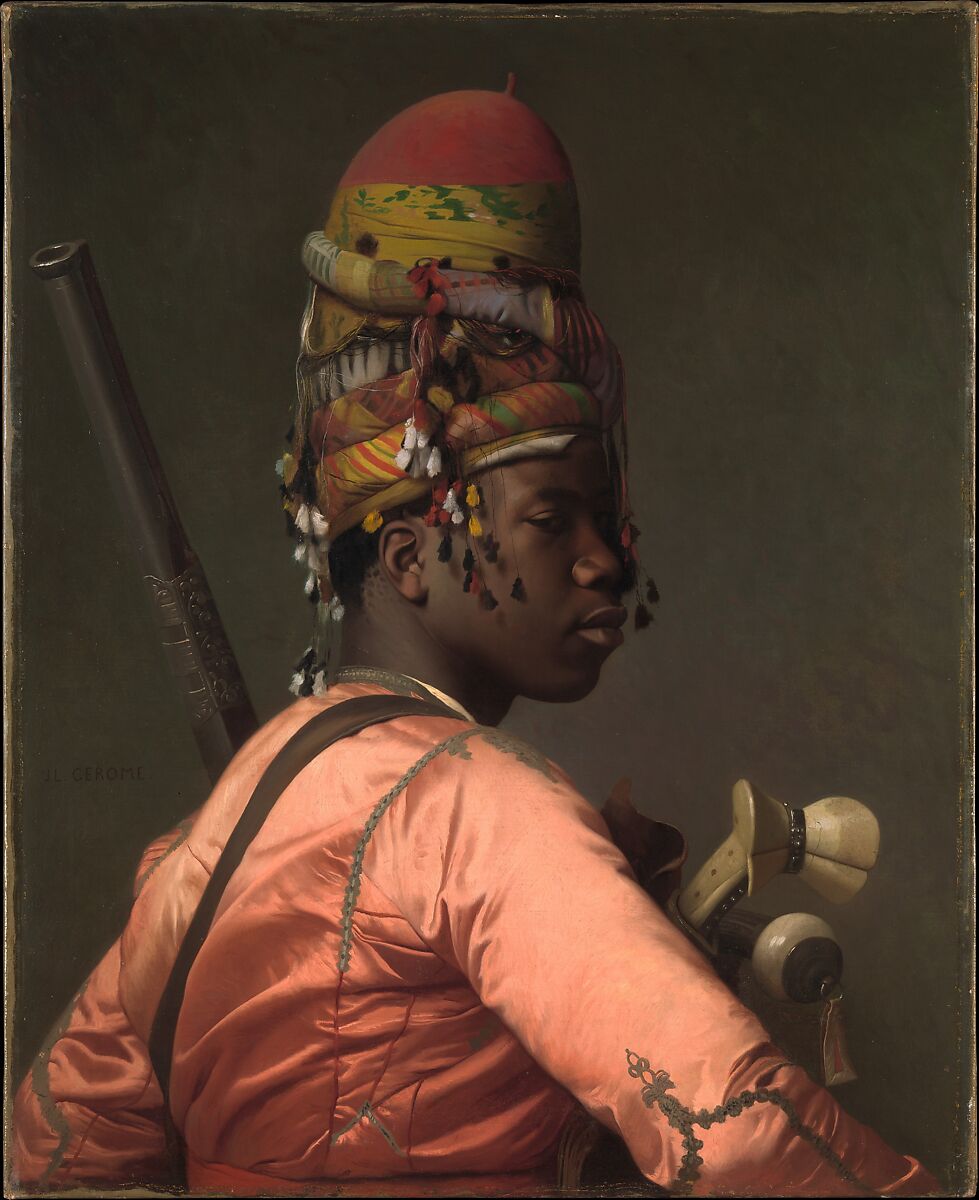
The Met’s catalog explains that Gérôme dressed a model in his Paris studio using garments and accessories acquired abroad after his 1868 journey. The painting’s detailed texture can make it seem documentary, but the catalog establishes a constructed studio scene. Its title and costume do not prove the sitter’s occupation, nationality or beliefs. No audio observation is claimed; the catalog’s audio transcript is unavailable and is not required here.
Complete textual alternative: the single figure occupies most of a vertical canvas. Light emphasizes a coral satin sleeve and layered, tasseled headwear against a dark ground. The head turns toward the viewer. Visible accessories suggest the role named by the title, but the catalog identifies a studio model. The reasoning task is to distinguish visible treatment, cataloged production and an unsupported claim about a whole population; all necessary evidence is in this description and the previous paragraph.
Jennifer Meagher’s 2004 Met essay on Orientalism connects European travel, published representations and imperial encounters with changing subject matter and styles. Such work could mix observation, imagination, admiration and unequal power. That does not make every painting the same political statement. Compare the cataloged studio construction with Ferry’s explicit parliamentary argument: both help investigate European representations, but their genre, audience and evidentiary function differ.
7. Counterclaims and modernization were active choices
Naoroji’s 1871 argument in the credited university sourcebook uses a distinction between benefits and injuries to challenge unequal British rule. Its page does not identify a printed source edition, so precise uncertain financial quantities are not reused. The Indian National Congress’s retrospective timeline connects organization in 1885 with later speeches about shared national belonging. It is a party’s selection of its history, not every resident’s voice.
Education in European political ideas could provide terms with which to challenge the denial of professed equality. It did not invent all local agency or make every critic adopt the same future state. Some defended existing sovereignty, others sought representation or national independence, and still others advanced religious authority. Retain the earlier Ethiopian and Sudanese distinctions instead of relabeling all resistance secular nationalism.
Modernizing a local economy could also strengthen bargaining power without being a nationalist petition. The existing state-reform investigation supplies the Meiji oath, the 1872 Tomioka institution, Qing reform arguments and Ottoman educational provisions. Those records distinguish adopted knowledge, domestic adaptation, operating institutions and contested authority. Japan’s later imperial expansion also warns that resisting unequal power does not guarantee equal treatment of others. No biological production or industrial process from those histories is assigned here.
Independent explanation and changed-condition transfer
Write privately before opening the model. Connect one imperial motive, one institutional capacity and one response. Use a dated primary record and a differently situated witness. Add the painting as evidence about representation, not as proof of ordinary life across a population. Explain how political independence can coexist with economic constraint and how an agreement can manage rivalry without ending it.
Original model after your first attempt
Ferry’s speech combines markets and national rank with a hierarchy that should be criticized rather than accepted. The Moroccan act illustrates how a sovereignty formula can coexist with international banking privileges. Neither proves that every proposed benefit reached residents. Faster communication could support administration, while an opponent could use institutional claims of equality to criticize exclusion. Gérôme’s detailed studio picture is evidence of a European representation shaped by travel and collected objects; it cannot establish that its model represents every person assigned the title. A strong explanation relates these records without treating them as independent measurements of the same outcome.
Changed condition — fictional commercial archive: export receipts rise from 100 to 130 units; recorded creditor payments rise from 20 to 50. No other cost, wage or household records survive. An editor proposes the caption “Rising exports prove a 30% rise in local prosperity.” Evaluate it without inventing missing observations.
Transfer feedback
Gross receipts rose 30%, but receipts minus the one recorded payment remain 80 units in both periods. That remainder is not profit because other costs are missing, and it is not household income. The records cannot establish the proposed welfare claim or its opposite. A defensible caption separates the measured commercial changes from missing distributional evidence. The numbers are original fictional units, not estimates of any historical country’s finances.
Review criteria: distinguish claims from implementation, preserve each witness’s edition and perspective, avoid universal technological or cultural explanations, and identify missing evidence rather than requesting sensitive personal research. This is an authored reasoning opportunity, not official authorization, human calibration or automatic mastery.
Worked example
Fictional receipts 100−payments 20 and receipts 130−payments 50 both leave 80; missing costs mean this is not profit or household income.
Check the reasoning, then transfer it
Loading response history…
Keep your evidence and choose a next step
Loading saved lesson status…
What will you take away?
Keep a private reminder for yourself.
Open your existing lesson notes and evidence.
Loading your journal…