

Emotion, Revival, and the Work of Artistic Form
Compare emotion, revival, artistic choices and contested cultural authority.
Your task: Defend a source-specific comparison of feeling, form and authority with an alternative interpretation.
Open the investigation · Read the explanation · Your saved evidence
Starting recap and vocabulary
Credit earlier Enlightenment, national belonging, visual interpretation and wartime evidence; familiarity is not unseen performance.
- Romanticism
- Diverse cultural challenges emphasizing feeling, imagination and other themes; not one universal program.
- Realism
- Attention to ordinary subjects and social relationships, still constructed rather than transparently neutral.
Can appeals to feeling challenge and create authority?
Compare one textual and one visual or musical-documentary witness by date, genre, formal choice and historical limit.
Separate observation, attributed claim and outcome using the supplied text equivalents.
Make a provisional claim
Loading saved evidence…
Inspect evidence and test an explanation
The investigation controls appear when your local evidence is ready.
Connect evidence and mechanism
Emotion, Revival, and the Work of Artistic Form
An account of emotion is not necessarily an argument against thinking. A painting that refuses crisp outlines can still be carefully constructed. A religious revival can emphasize personal experience while maintaining an organization. This investigation compares these different kinds of evidence without asking you to adopt a belief or perform a ritual.
Start with a private prediction: Does an appeal to feeling challenge authority, create authority, or sometimes do both? Keep that first answer before reading the model. The sources below are a limited historical comparison, not a test of your faith, personality, or emotional response. All reasoning can be completed using the descriptions and documentary summaries; no music playback or image access is required.
1. Conscience, experience, and chronology
Rousseau’s Émile appeared in 1762. The French National Assembly library’s manuscript history documents an intermediate manuscript revised during printing and the work’s condemnation in June 1762. That is evidence of contested authority, not proof that every reader accepted its advice.
In the Savoyard Vicar passage, Rousseau gives a fictional speaker an argument that conscience involves inward sentiment rather than intellectual calculation alone. Read the selected Part IV paragraph about conscience in the Fordham transcription. Its heading says 1782; do not confuse that label with the work’s first publication in 1762. The electronic witness does not identify a translator clearly enough to support claims about exact original French wording. We use its argument, not its dated editorial biography or judgments of other religions.
This is a philosophical argument voiced through a literary character. It neither measures how most Europeans felt nor shows that Rousseau rejected every use of reason. Compare it with the political argument already studied in Enlightenment public discussion: an author can use reasoned criticism to contest reason’s exclusive authority.
The New Room in Bristol commemorates John Wesley’s journal account of 24 May 1738. Its institutional summary describes his reluctant attendance at a meeting and his reported inward assurance. Attribute that experience to Wesley and the later account to a Methodist heritage institution. The linked journal file was not accessible in this authoring check; the summary is not being passed off as inspected manuscript text.
The 1738 date precedes the later Romantic movement. Methodism’s emphasis on experienced faith can be compared with later attention to feeling without claiming that nineteenth-century Romantic art caused an eighteenth-century revival. Nor does one reported experience establish every participant’s beliefs. Religious revival and Enlightenment criticism overlapped; neither replaced the other everywhere.
2. A literary manifesto does not describe every poem
Wordsworth’s revised 1802 Preface to Lyrical Ballads defends ordinary language and familiar lives as poetic subjects. He connects poetry with recollected emotion, while also describing reflection and deliberate composition. In the same essay he criticizes pressures associated with expanding towns and repeated sensational stimulation. These are an author’s claims about writing and contemporary society, not a survey proving that all urban readers were alike.
The work offers a Romantic challenge to inherited hierarchies of subject matter and style: rural experience and an individual mind can matter without a classical hero. Yet “Romantic” is not a single recipe. Intuition, nature, national history and the supernatural recur in different combinations; a work need not contain every theme. The Preface is evidence of a literary program, and a poem would be needed to test how consistently that program was realized.
3. Two paintings, two ways of making significance
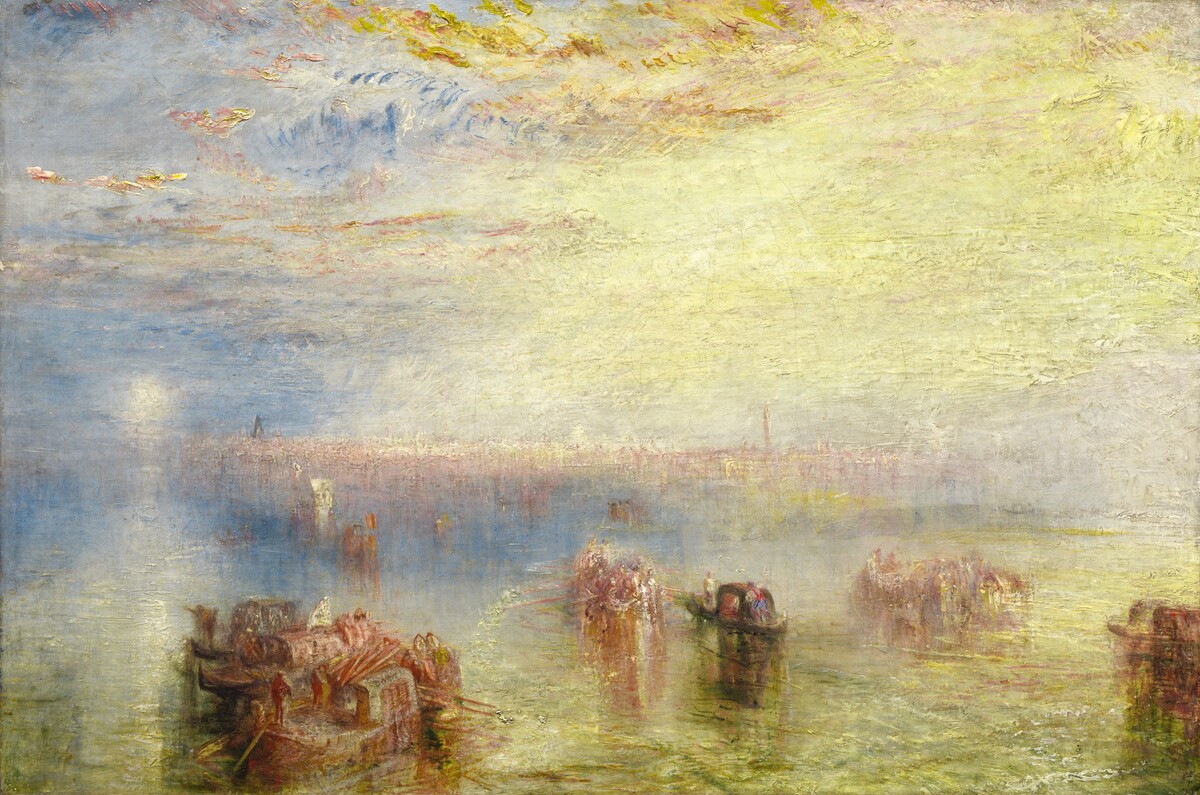
Text equivalent: Sky occupies much of the image. Yellow light blends into blue and pink; distant buildings are difficult to separate, while boats in the foreground are darker. Visible strokes and reflections make atmosphere conspicuous. The catalog supplies the title and date; it also identifies Byron’s poetry in the exhibition description. The image alone cannot identify what every passenger thought or measure the city’s weather. An interpretation that the atmosphere invites imaginative attention is defensible; calling it a literal inventory of Venice is less so.

Text equivalent: Three dressed adult figures dominate the foreground beside a smaller standing girl. A basket, parasol, dog, cattle and rocky valley make ordinary rural relationships visible. The Met identifies the adults as Courbet’s sisters and the gesture as giving alms. Those identifications come from catalog research, not merely looking. The museum records hostile reception at the 1852 Salon, including objections to dress, proportions and composition. Realism could challenge assumptions about which people deserved serious representation; it was not simply a neutral camera or a guarantee that social inequality had disappeared.
Compare one formal choice in each image: indistinct atmosphere versus prominently placed figures, or the relation between foreground and distance. Then offer an alternative reading. Courbet’s attention to ordinary people can expose hierarchy, but the charitable gesture can also preserve a distinction between giver and recipient. Both interpretations need a visible detail and contextual evidence; neither licenses assumptions about the real child’s life.
4. Music, patronage, and political memory
The Beethoven-Haus record for the Third Symphony distinguishes an erased Bonaparte title from the familiar story of a whole title sheet torn apart. It also records Prince Lobkowitz’s patronage and Beethoven’s changing references to Napoleon. The surviving document and later anecdote do not support identical claims.
The Berlin Philharmonic programme note by Christoph Vratz supplies a text-only formal comparison: the four-movement plan remains, but development expands, a funeral march draws on republican musical associations, and the finale develops a recurring theme through variations. This is expansion and reworking of inherited form, not the disappearance of structure. Its quoted 1807 review combines admiration with criticism of the finale. Use the programme as an attributed analysis and reception witness, not as your own listening report. Its premiere anecdote is not substituted for Beethoven-Haus’s more cautious documentary chronology.
This documentary route establishes a relationship among an individual composer, heroic political memory and aristocratic support. It does not pretend that a title proves how a listener experienced the symphony. No recording has been observed for this lesson. Use the title/patronage evidence to explain why artistic independence and dependence could coexist, rather than inventing an audible crescendo or assigning a compulsory performance.
Revolution and national politics made emotional attachment publicly consequential. In the earlier Hambach and national belonging investigation, Wirth’s 1832 language could promise liberation while excluding others. Emotional appeal is therefore neither automatically democratic nor automatically irrational. Ask who can join the imagined community and who is placed outside it.
5. Write, compare, and revise
Privately write a claim comparing one textual witness and one visual or musical-documentary witness. Identify their dates and genres; distinguish a formal choice or reported experience from an observed social outcome. Include one historical relationship to religious authority, national politics, industrial change or patronage. End with a plausible alternative interpretation and the evidence that would help distinguish it. Do not invent attendance totals or audience responses.
Compare with an annotated model after your first response
Wordsworth's program and Courbet's rural scene both make subjects outside elevated classical history worthy of attention. The Preface explicitly argues for a literary choice; the painting and its documented reception show a visual choice that provoked criticism. This is a similarity in challenges to cultural hierarchy, not proof that their forms, politics or audiences were identical. Courbet's charity scene may question unequal status while also representing it as an orderly relationship. To decide how an audience interpreted that tension, I would need specific reviews, not my reaction alone.
The model names different genres, makes a bounded comparison and leaves an outcome unresolved. Another defensible answer could compare Wesley's reported experience with Beethoven's documentary ambiguity, provided it does not treat either as evidence of universal belief.
Changed condition: A new catalog corrects an exhibition date but leaves the painting’s visible features unchanged. Which parts of your claim survive? The description of color or placement can remain; a claimed response to an event after the corrected date must be reconsidered. Conversely, a changed attribution of a memoir does not erase a separately surviving title-page erasure. Revise the affected inference rather than discarding all evidence.
A final reflection concerns the argument, not your own beliefs: When does historical feeling become evidence, and when is it only the historian’s projection? Keep the private first response alongside the revision. Reading feedback does not establish mastery, and this activity makes no claim to record a new assessment attempt automatically.
Worked example
Courbet’s ordinary subjects can challenge cultural hierarchy while the charitable gesture still represents unequal status.
Check the reasoning, then transfer it
Loading response history…
Keep your evidence and choose a next step
Loading saved lesson status…
What will you take away?
Keep a private reminder for yourself.
Open your existing lesson notes and evidence.
Loading your journal…