

Modern Representation, War Experience, and Women's Participation
Compare modern representation, a wartime voice and changing participation without universal conclusions.
Your task: Distinguish formal innovation and documented participation from equal rights or universal experience.
Open the investigation · Read the explanation · Your saved evidence
Starting recap and vocabulary
Credit earlier Enlightenment, national belonging, visual interpretation and wartime evidence; familiarity is not unseen performance.
- Modernism
- Diverse experiments with inherited cultural forms, not one date or a unanimous worldview.
- Denominator
- The population or total to which a reported share refers.
Do new artistic forms and work roles establish equal freedom?
Compare an artwork, an attributed war-related voice and a participation record; preserve each denominator and limit.
Separate observation, attributed claim and outcome using the supplied text equivalents.
Make a provisional claim
Loading saved evidence…
Inspect evidence and test an explanation
The investigation controls appear when your local evidence is ready.
Connect evidence and mechanism
Modern Representation, War Experience, and Women’s Participation
Can a change in artistic form, a protest text and a rise in employment all be called “modernization”? Only if we explain what changed in each case. A painting does not measure a workforce. A speaker’s disillusionment does not establish everyone’s outlook. More wartime work does not automatically mean equal pay or lasting political power.
Keep a private first response to this claim: “New forms and new roles made Europeans equally free.” Predict which word is hardest to support. The task below uses actual works and documentary summaries, with a complete text route. No personal experience, reenactment, political declaration or graphic material is required.
1. Impressionism and the conditions of seeing
Margaret Samu’s Met account of Impressionism situates the independent 1874 Paris exhibition outside the official Salon. The exhibitors did not all share one style. Some critics treated loose brushwork as unfinished; other writers welcomed contemporary subjects and innovative representation. That disagreement is evidence of reception, not proof that every viewer was offended or that artistic independence removed commercial constraints.
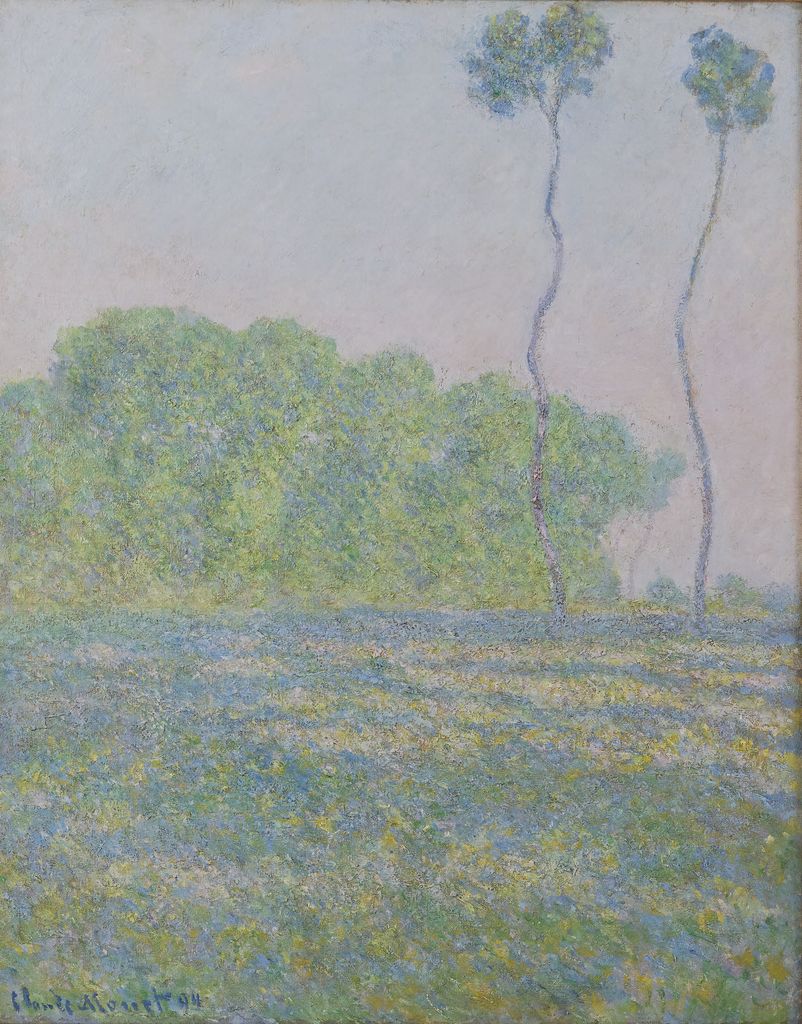
Text equivalent: Short colored marks make grass, foliage and light rather than sharply outlining every leaf. Two slender trees extend high against a pale sky; a broader group occupies the left. The catalog identifies Giverny and 1894. An interpretation of changing light is supported by the surface and context, but the work is not a botanical inventory or a record of every moment that spring. Subjective selection and an identifiable landscape can coexist.
2. Post-Impressionist structure and Cubist signs
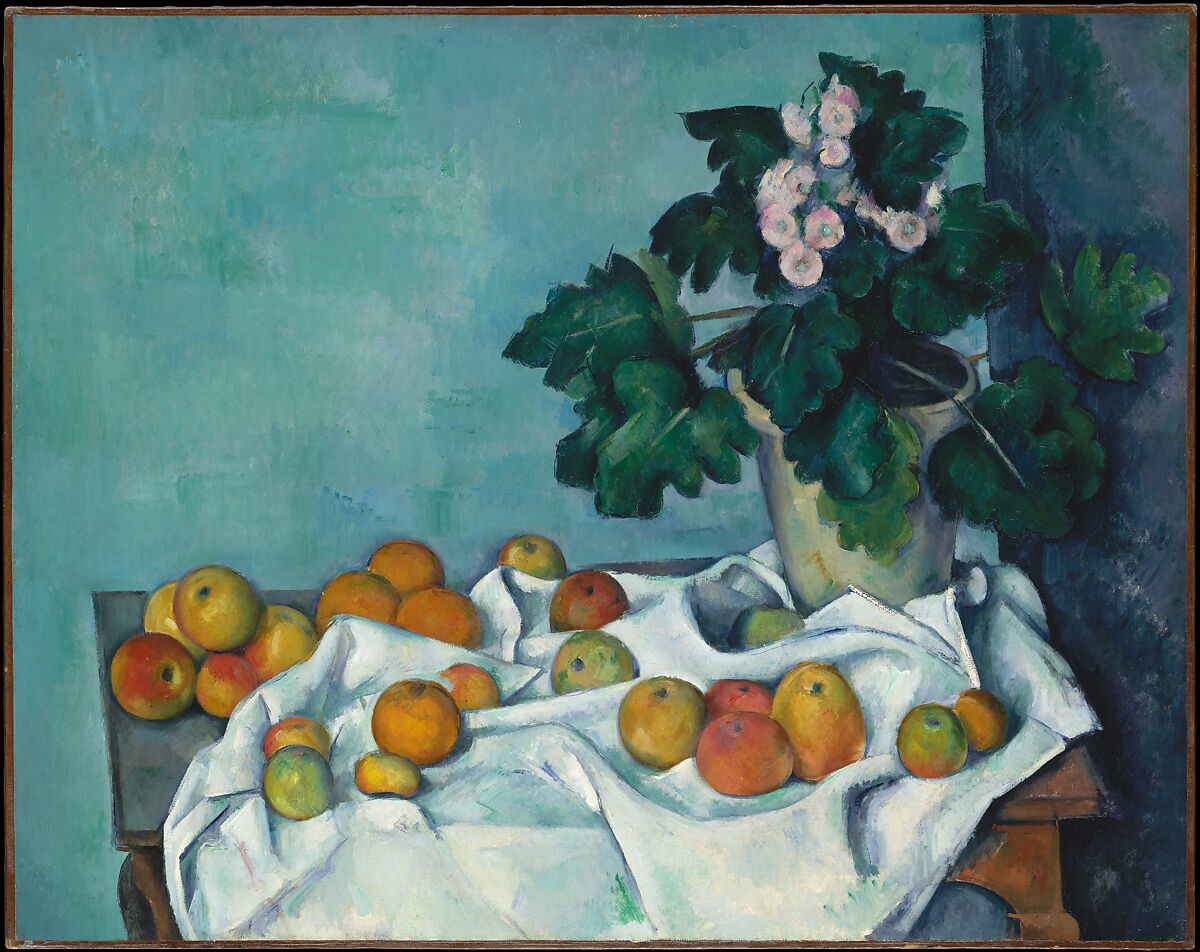
Text equivalent: Apples remain recognizable, but color patches, folded cloth and angled edges organize the picture. A flowering plant occupies the right side; the tabletop does not read as a mechanically exact diagram. The catalog’s date is approximate. Compare this deliberate organization with Monet’s field of marks. Calling Cézanne simply “more realistic” or “unable to draw” would evade the question of what the arrangement does.
Post-Impressionism is a grouping for different responses to Impressionist practice, not a single organization or a command to stop depicting objects. Some artists made structure, symbolism or expressive color more conspicuous. Sabine Rewald’s Met account of Cubism connects Braque’s 1908 landscapes with Cézanne and describes the later use of fractured forms and contrasting viewpoints. Influence does not make the works identical or require a straight line of inevitable progress.
For a third documentary witness, use the Met’s catalog for Braque’s Violin: “Mozart Kubelick”, dated Paris, spring 1912. It identifies wordplay around violinist Jan Kubelík and the painting’s appearance in the 1913 Armory Show. The spelling in the title is retained rather than silently corrected. This image is rights-restricted and is not reproduced here; no full-resolution inspection or audio performance is claimed. Equivalent evidence card: the catalog identifies an instrument, written names and a pun within a Cubist work, linking visual representation with signs and cultural references. Use that documented relationship, not an invented description of unseen paint texture. Monet’s meadow, Cézanne’s arrangement and Braque’s catalog evidence do not all abandon representation in the same way.
3. War changed voices without producing one universal outlook
Cambridge University Library’s 2014 exhibition account pairs Sassoon’s early Absolution (1915) with later critical poems. Its selected literary discussion traces a change from defense and liberation toward satire of public assurances. Read only this framing and the comparison of attitudes; the site’s adjacent tactical and clinical material is not assigned.
The National Army Museum supplies selected text of his 1917 declaration, which distinguishes his original understanding of the war from his later criticism of its political purposes. The museum dates its composition to June and its publication and parliamentary reading to 31 July. Attribute the argument to Sassoon; it does not prove that all soldiers agreed or that his proposed interpretation was an uncontested account of every government’s intention.
The phrase “lost generation” can describe a cultural interpretation of dislocation and disillusionment, not a clinical diagnosis or a census category covering every survivor. Artistic experiment also predates 1914, as the dates above show. War intensified cultural questioning and changed opportunities, but it did not invent modernism or erase every form of confidence. The existing wartime media investigation supplies a complementary distinction between official appeals and measured persuasion. Do not replace those particular voices with a universal story.
4. Women’s work: participation is not the same as equality
The UK Parliament’s historical summary reports women’s share of total employment rising from 24% in July 1914 to 37% in November 1918. That is a 13-percentage-point increase, not a claim that 37% of all women worked or that every woman’s wages increased. It also notes unequal pay and the continuing importance of suffrage campaigning. Wartime service was part of the political context, not the sole cause of enfranchisement.
For the Second World War, the British government’s 2015 commemoration describes women’s call-up for war work from 1941 and participation in transport, factories, agriculture and public services. This is a retrospective institutional account. Its commemorative purpose highlights contribution; it is not a complete record of consent, pay or all national experiences. We study participation and policy, not how to operate equipment or conduct military activity.
The Open University’s history of women on Scottish railways across both wars provides a useful boundary: women occupied wider roles, faced opposition and unequal treatment, and after 1918 some left or were dismissed while others remained. New opportunities and persistent inequalities could coexist. This is a bounded British comparison, not a prevalence estimate for all Europe. Different states, occupations, ages, family circumstances and legal rules require their own evidence.
The existing 1918 British participation investigation remains the place to test eligibility and actual participation under the authored rules. Employment, voting eligibility, holding office and equal pay are separate outcomes. Do not infer one automatically from another.
5. Three records, three kinds of change
Privately write a short comparison using one artwork, one war-related voice and one employment or participation record. For each, name a change, the evidence for it and a claim it cannot establish. Then connect the cases without making one cause all the others. You may use only the provided text equivalents; an answer is not better because it claims an image or performance was observed when it was not.
Compare with an annotated model after your first response
Monet's surface makes perception and selection visible while retaining a recognizable landscape. Sassoon's declaration records a particular soldier's change in interpretation, not every soldier's response. The parliamentary employment proportions show a larger female share of recorded work, while the same account and the railway history preserve inequalities. These are distinct challenges to established expectations. Together they complicate an account of unchanged society, but they do not prove equal freedom, unanimous disillusionment or a direct causal path from painting to employment.
The model separates an interpreted work, an attributed statement and an aggregate statistic. It also identifies a counterexample to automatic emancipation: wider participation can coexist with unequal pay or later displacement.
Changed condition — fictional transfer, not an observed workforce: A town’s archival teaching table shows 200 women among 800 workers in year A and 300 among 1,500 in year B. The number rises by 100, or 50%, but the share falls from 25% to 20%. A temporary hiring rule also expires after year B. Rewrite a caption claiming “women’s share rose and permanent equality followed.” Both inferences fail: the denominator reverses the first, and neither the count nor an expiring rule establishes the second. A correct caption can report the increased count while withholding claims about share, pay or lasting rights.
End by naming the additional documentary evidence you would need, such as a continuing eligibility rule, pay records with comparable categories, or later employment data. Do not collect personal disclosures or contact participants. Keep your first response and revision privately. The supplied model is guidance, not an official score, clinical assessment or automatic completion record.
Worked example
A fictional rise from 200 to 300 women workers increases the count 50%, but 200/800 to 300/1500 lowers their share from 25% to 20%.
Check the reasoning, then transfer it
Loading response history…
Keep your evidence and choose a next step
Loading saved lesson status…
What will you take away?
Keep a private reminder for yourself.
Open your existing lesson notes and evidence.
Loading your journal…