
Landscape and national culture: reading The Oxbow
Compare a preparatory sketch and finished landscape, test competing interpretations and investigate how art reaches audiences.
Your task: Support an interpretation of a landscape with visible evidence while distinguishing artistic choices, production context and unmeasured public reception.
Open the investigation · Read the explanation · Your saved evidence
Starting recap and vocabulary
A landscape painting selects a viewpoint, arrangement and emphasis. Nineteenth-century artists worked through exhibitions, patrons and markets. Images can contribute to ideas about a nation without representing everyone within it.
- Composition
- The arrangement and relationships of elements in an artwork.
- Patron
- A person or institution supporting an artist, sometimes by commissioning or purchasing work.
- Reception
- How particular audiences encountered, interpreted or responded to a work.
- Study
- Preparatory work used to explore a later artwork’s form or arrangement.
How can a landscape make an argument without stating it in words?
Annotate two images, compare three compositional choices, defend and challenge an interpretation, map production and reception evidence, and write two museum labels.
Use a three-column observation/interpretation/missing-evidence chart and support a short museum label.
Make a provisional claim
Loading saved evidence…
Inspect evidence and test an explanation
The investigation controls appear when your local evidence is ready.
Connect evidence and mechanism
Look before reading the label
A landscape can direct attention through scale, viewpoint, light and arrangement. Begin with the finished painting below. Write five observations using location words such as foreground, left, right and distance. Keep interpretation in a separate column: “darker clouds at left” is different from “the artist condemns settlement.”
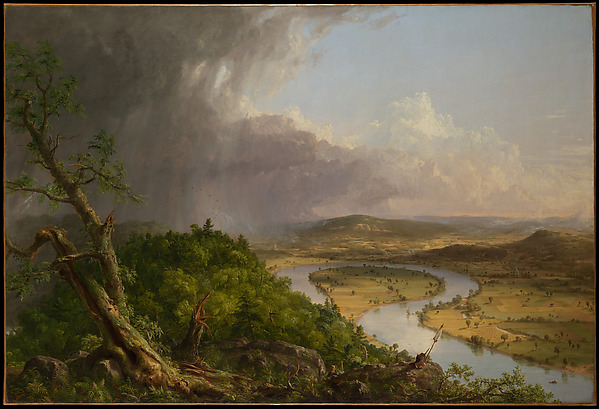
Text description for the same observation task
A damaged, angled tree occupies much of the left foreground. Nearby vegetation is dark and irregular. The sky is darker at left and brighter toward the right. A winding river makes a large bend through the middle distance, surrounded by fields divided into smaller patches. Hills extend toward the horizon. Use these described features to build the same observation-and-interpretation chart. The description does not prescribe a single meaning or establish who owned the land.
Predict an argument, then test an alternative
Choose a provisional reading: celebration of cultivation, concern about landscape change, or tension between both. Identify two features supporting it. Then make the strongest alternative reading you can from the same image. Do not treat a menu of interpretations as a multiple-choice answer key; a different defensible interpretation may be possible.
The Met’s object account reads the composition in relation to Euro-American settlement. That is curatorial interpretation, distinct from the primary image and from your own argument. Avoid describing the wooded foreground as historically empty or ownerless land. The absence of clearly identifiable people in a region of a painting cannot establish absence of inhabitants, prior land use, sovereignty or claims.
Compare making with looking
Now inspect Cole’s preparatory oil study. The two works are displayed to fit the page, not at their relative physical sizes. The study is 14 × 23.8 cm; the final canvas is 130.8 × 193 cm. Both are dated 1836 in the museum catalog.
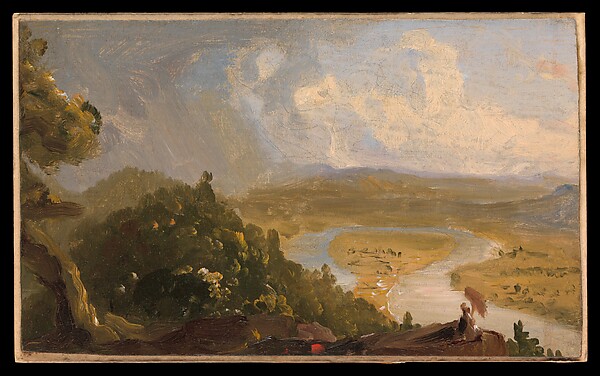
| Feature | Learner action | Evidence boundary |
|---|---|---|
| River bend | Describe what remains recognizable across both works | Shared subject does not mean identical composition |
| Foreground | Compare the prominence and definition of trees and vegetation | Detail is an artistic choice, not a land survey |
| Sky and light | Compare contrasts and their effect on attention | Emotional effect is an interpretation to support |
| Surface and scale | Compare broad marks with more resolved forms; use catalog dimensions | Digital display width does not measure object size |
Draw two thumbnail outlines on paper using only three areas: foreground, river/fields and sky. Change which area dominates in a third, explicitly invented version. Explain how the changed arrangement affects your interpretation. Keep your drawing labeled as an analytical sketch, not a restoration or historical variant of Cole’s work.
Check the composition comparison
Both works organize attention around a river bend and a wooded foreground, while differing in detail and emphasis. The comparison supports study of artistic choices. It does not show that one is a photograph, that every feature was invented, or that two independent observers agreed. The museum’s process account describes an earlier on-site pencil drawing and a later studio oil study; that pencil drawing is not supplied here. Keep the two visible objects separate from this third work mentioned in the account.
Explain why this belongs in social studies
National culture is produced through particular people, objects and institutions. Landscapes can make selected places important to a story about a nation. They can also invite disagreement about cultivation, development and nature. That does not make a single painting the voice of everyone in the United States.
The National Park Service biography places Cole in the movement now called the Hudson River School and describes exhibitions, travel and patrons. His migration from England complicates a claim that national culture developed in isolation. The biography’s account of Reed’s commission concerns The Course of Empire; do not silently apply that commission to The Oxbow.
Build an evidence chain: artist and preparation → completed object → exhibition or circulation → particular audience response → wider influence. Put the supplied images and contextual records at the stages they support. Identify a dated exhibition catalog or review you would need before asserting who saw this painting or how they reacted. Do not invent attendance, sales or opinions from the painting’s later fame.
Apply: write two labels that can withstand challenge
Write a 120–180-word museum label defending your preferred reading. Cite both image IDs, identify two visual details and explain how they support your argument. Add one qualification about intention, reception or land history. Then write a 60–100-word counter-label giving a plausible alternative. Revisit your first label: does it acknowledge the strongest contrary detail?
Use these distinctions when revising:
- Observation: name a visible feature and its location.
- Interpretation: explain a possible meaning and why the feature supports it.
- Intent: seek an artist’s statement or other evidence before claiming what Cole privately meant.
- Reception: seek records of particular audiences, with dates and context.
- Historical land relations: investigate community histories, land records and sovereignty rather than inferring them from painted appearance.
Transfer to an unfamiliar image claim
In an original fictional packet, a railway poster places a bright station beside a dark old road. An advertisement announces an exhibition of the poster. No visitor comments, ticket sales or travel records are supplied. An exhibit claims: “The poster proves every resident abandoned roads.” Identify the persuasive device, separate announced display from observed reception, and request one record that could test the behavioral claim.
Check the unfamiliar poster claim
The contrast supports a reading of promotion, but neither the poster nor an exhibition announcement establishes everyone’s travel behavior. A dated attendance record could address exposure; route-use records could address behavior; neither alone would prove the poster caused a change. Recognizing persuasion makes the image useful evidence of communication, not useless evidence. This is a fictional transfer task, not an actual nineteenth-century advertisement.
High school: use the observation chart and two labels. AP practice: connect this case to national cultural production and land/development debates while maintaining source limits. Introductory college: inspect an additional dated artist statement or review and compare its purpose and dependence with the museum accounts. Include community perspectives absent from this packet without inventing testimony.
Return to canal communities to compare representation with infrastructure records. Neither source type substitutes for the other. Literature, religious thought, print audiences, Indigenous cultural production, Black cultural institutions and regional variation still require broader treatment. Save your observations, competing labels and revised argument in the notebook; this single artwork comparison does not complete the national-culture topic.
Worked example
“The right side is lighter and contains patterned fields” is a visual observation. “The contrast celebrates cultivation” is an interpretation. “All contemporary viewers welcomed settlement” is a reception claim requiring evidence beyond the image. A convincing argument labels these different jobs.
Check the reasoning, then transfer it
Loading response history…
Keep your evidence and choose a next step
Loading saved lesson status…