
Canal communities: power, markets and local costs
Compare industrial promotion and canal petitions, diagram different effects of infrastructure, and distinguish a proposed remedy from a completed one.
Your task: Explain how the same transport system could improve commercial connections while imposing local costs, using attributed records and a bounded transfer model.
Open the investigation · Read the explanation · Your saved evidence
Starting recap and vocabulary
Canals connect waterways and markets. A feeder supplies canal water; a dam can provide water power for industry. A transport corridor also crosses land and existing routes, so regional connections can coexist with local access problems.
- Feeder
- A water supply channel or stream serving a canal.
- Broadside
- A printed sheet used for announcements or public communication; its purpose and audience matter.
- Distributional effect
- How benefits or costs fall on different people or groups, rather than their combined amount.
- Compensation
- A payment or other remedy for a loss; a request does not establish receipt.
Can a canal connect a region to markets while making a nearby household’s daily travel harder?
Compare four catalog records and inspect the separate primary-map scan, draw separate industrial and household-access diagrams, identify a proposed remedy, analyze an unfamiliar cost ledger and write a qualified public-history panel.
Label the actors, problems and proposed remedies; compare household access with regional transport.
Make a provisional claim
Loading saved evidence…
Inspect evidence and test an explanation
The investigation controls appear when your local evidence is ready.
Connect evidence and mechanism
One canal, different connections
An invented museum panel says: “Canals connected everyone, made every household richer and solved local transport problems.” Write a prediction: could a new connection at one scale create a barrier at another? Choose two outcomes that would test the panel instead of using the single word “progress.”
The Erie Canal opened in 1825. This inquiry examines selected records from 1829, through modern catalog descriptions supplied by the New York State Archives Partnership Trust. The descriptions introduce authentic archival objects, but they are not the objects themselves. A separate unchanged map scan appears below for visual inspection; the other cards remain catalog summaries. No complete primary transcription or measured geometry is supplied. The core tasks and map work offline; fuller archival reading is an extension.
Try: compare purpose before comparing claims
Read the four catalog-summary cards and separate primary-image card in Experiment. Record date → historical actor → requested or promoted action → intended audience → outcome still to investigate. A catalog author describes an earlier document; keep those two voices separate. Do not put quotation marks around our paraphrases as if they were an 1829 speaker’s words.
| Record | Investigative action | Do not infer from this alone |
|---|---|---|
| Waterford promotion | Separate power supply from market access | Actual production, wages or universal journey times |
| German Flatts petition | Mark the harm and requested remedy | Official agreement or completed works |
| Attached map | Identify its relation to the petition | Independent corroboration or an as-built survey |
| Van Patten request | Identify the access problem and requested compensation | Approval, payment or all households’ experience |
A promotional document and a petition have different purposes. That does not automatically make either false. It changes the questions you ask and the records you seek to test their claims. An official catalog is useful for identifying a record, but it does not replace reading the complete document or checking implementation.
Inspect the original map before drawing your own
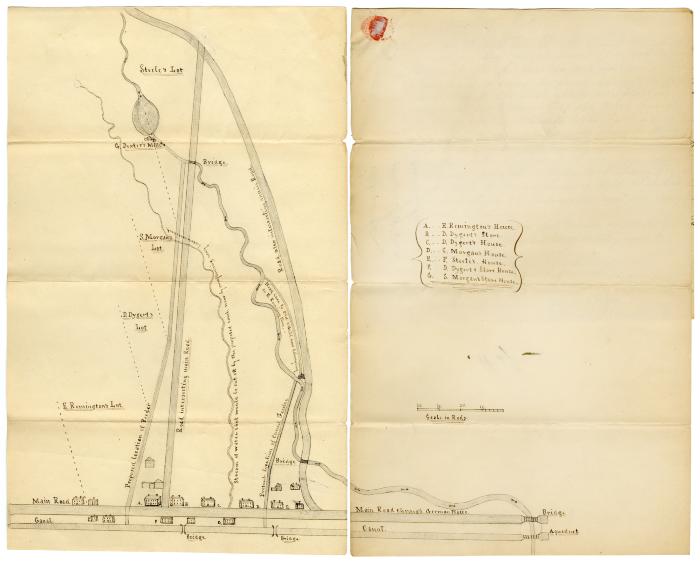
Observation task: locate a canal label, a road label, a bridge label and the lettered key. Describe relative positions without assigning compass directions from page orientation. Then compare the scan with the catalog’s description of a proposed feeder accompanying a petition. Do not count the image and its catalog as independent reports of construction.
Make three notebook columns: visible in the scan / supplied by catalog / interpretation to test. Put at least one entry in each. Mark uncertain readings rather than completing words from expectation. The scan has a scale bar, but the small display is not a reliable basis for an exact survey. Identify units only if legible, check endpoints and reproduction distortion, and seek a suitable higher-resolution image before calculating distances. Browser pixels are not historical distance units.
Text description and map-reading feedback
The two-panel drawing has visible folds. Its lower part includes a labeled canal and nearby road, small building symbols and crossings. Longer lines and waterways run through the left panel. A lettered key and scale bar occupy the right panel. These observations do not identify every building, ownership right or engineering dimension. The catalog supplies the date, archival relationship and proposed-feeder description; do not present these as independently deciphered inscriptions. This description supports the evidence-classification task without requiring visual reading of small handwriting.
A drawn route is evidence of representation. Whether it describes an existing feature, a proposed alteration or both requires labels and context. The image alone does not establish Board approval, completed construction or resolved flooding. Compare it with the petition and later administrative records before claiming an outcome. Keep unresolved labels and measurements unresolved.
Predict: draw two mechanisms
Make two diagrams, keeping the outcomes distinct. The following is an original conceptual diagram, not a map or a reproduction of an archival image.
Water power → production capacity
Transport route → access to markets
Investigate whether these opportunities became actual output and sales.
New corridor crosses an existing route → a crossing may be needed
Crossing cost → request for a remedy
Investigate the specific access change, decision and payment.
Put the relevant source ID beside each diagram. Mark arrows as reported, proposed, or not established here, using words as well as line styles. Add a third diagram for the feeder-water complaint and proposed alternative. Do not locate Waterford, German Flatts and Van Patten’s household on one invented town map. These are separate records and places or actors, not interchangeable observations of a single site.
Experiment: change the connection
On a separate sheet, draw an explicitly fictional house and field on opposite sides of a canal, with no crossing. Add a bridge. Explain the access mechanism that changes, then list what your diagram cannot show: construction cost, suitability, maintenance, ownership, consent and whether anyone paid compensation. Now remove the bridge and move the field to the same side as the house. Which previous access claim no longer follows?
Check the access experiment
A crossing can restore a route between the fictional house and field; moving both to one side removes the particular need to cross between them. Neither sketch establishes travel time, affordable construction or legal access. A diagram can expose a mechanism while leaving its magnitude and implementation unmeasured. Your schematic is not evidence about the actual property’s shape or distances.
Understand: a proposal is one stage of a response
Arrange these evidence stages: reported problem → requested remedy and supporting plan → administrative decision → completed work or payment → observed outcome. Place the supplied records in the appropriate stages. Draw an empty box where evidence is absent. A map accompanying a request may strengthen your understanding of the request without independently confirming its claims.
Check the proposal and outcome distinction
The summaries identify promotion and requests, including an accompanying proposal map. They do not supply the Board’s resolution, a construction completion report, a compensation receipt or a later inspection. A favorable decision alone would still not prove the work was completed or the harm resolved. Conversely, missing outcome evidence in this small packet is not proof that officials never acted.
Write one archive request naming the next record and its purpose. For example, distinguish a decision record from a payment record rather than asking for unspecified “more sources.” Include the relevant catalog identifier from the source card so another researcher can follow the trail. A requested record remains a research lead until inspected.
Apply: inspect who receives a gain
Use this original fictional ledger, not historical Erie Canal prices: one merchant saves 30 credits per month in transport charges for six months. One household pays a one-time 120-credit crossing cost. No other benefits, costs or transfers are supplied.
Calculate each party’s stated change and the combined total. Then shorten the time window to three months. Keep the one-time cost in full; do not divide it by six merely because the reporting period changes. Explain why a positive total does not itself reimburse the household.
Check the ledger and time window
Six months gives 6 × 30 = 180 credits saved by the merchant, versus 120 credits paid by the household: 60 credits net across these two items. Three months gives 90 − 120 = −30 credits. These totals depend on the stated window and exclude unmeasured effects. The parties’ separate positions remain different. Adding their amounts does not transfer money or establish a comprehensive social surplus; neither calculation measures the historical petitions.
Now propose a compensation arrangement as a policy choice, clearly distinguishing it from an observed payment. Identify whose resources would fund it and what evidence would be needed about authority, costs and consent. Do not invent a historical settlement or assign monetary values to every harm merely to complete the ledger.
Continue: revise a public-history panel
Write a 180–250-word panel explaining how infrastructure could connect markets while imposing localized costs. Cite at least three source IDs and identify the relationship between the petition and map. Include one mechanism, one difference in scale, and one administrative record needed to test the response. Keep the fictional arithmetic separate from historical findings.
High school: use the two diagrams and source table to support your explanation. AP practice: relate transportation to market development and changes in community life, while distinguishing these selected cases from a national pattern. Introductory college: inspect a complete linked record and its catalog description, document transcription uncertainties, and seek an administrative follow-up. Keep the primary record, editorial summary and your interpretation distinct.
This packet does not supply workers’ wages or working conditions, Indigenous accounts of land and sovereignty, representative household outcomes, or the broader history of factories and railroads. Those are substantive remaining investigations. Connect this bounded case to expansion, markets and reform without treating a useful mechanism as complete coverage of the market revolution. Save your diagrams, revised panel and transfer reasoning in the source notebook.
Worked example
In the fictional transfer ledger, a merchant saves 30 credits each month. A household bears a one-time crossing cost of 120 credits. Over six months the stated amounts are 180 and 120 credits, leaving 60 credits in this restricted two-item accounting. The household has not received the merchant’s savings; neither compensation nor all social effects is established.
Check the reasoning, then transfer it
Loading response history…
Keep your evidence and choose a next step
Loading saved lesson status…