

Land, labor and the limits of economic freedom
Why did abolition not guarantee economic independence?
Your task: Develop a dated, source-specific argument answering: Why did abolition not guarantee economic independence?
Open the investigation · Read the explanation · Your saved evidence
Starting recap and vocabulary
Distinguish a legal rule, an implementation record, a representation and a later interpretation.
- implementation
- Putting an authorized rule or policy into practice, requiring evidence beyond the rule itself.
- source dependency
- A relationship in which one account derives information from another rather than independently observing an event.
- scope
- The people, places, dates and conditions to which a claim or rule applies.
Why did abolition not guarantee economic independence?
Identify operative permission versus title and later outcome.; Four-step employer-abuse and enforcement mechanism; report versus prescription.; Two visible features, one contextual claim; cannot infer individual charges or lease terms.; Postcard circulation, observation versus reverse annotation; no racial classification of people. Independent argument, counterclaim, source limits and revision.
Complete the accessible core source chart and independent argument; non-graphic private alternatives are fully available.
Make a provisional claim
Loading saved evidence…
Inspect evidence and test an explanation
The investigation controls appear when your local evidence is ready.
Connect evidence and mechanism
Land, labor and the limits of economic freedom
Inquiry: why did abolition not guarantee economic independence?
Freedom from legal ownership was a profound change. It did not automatically supply land, savings, tools, fair contracts or protection from coercion. This lesson follows four different records across forty-five years: Richard Brown’s land order, 1865; Bureau Circular No. 8, 1866; a photograph of juvenile prisoners working, 1903; and a North Carolina convict-camp postcard, circa 1910. They are not four images of one event.
You will distinguish land access, wage labor, sharecropping, credit and penal labor. These systems could interact, but they were not identical. The task is a documentary explanation of institutions and constraints, never a simulation of compelled work, an auction, a financial valuation of people or a tactical exercise.
Content note: the sources concern coercion, imprisonment and children compelled to work. You may use the non-graphic accessible descriptions and source guides throughout. No reenactment, personal experience or family disclosure is requested.
Concepts before causes
A Black Code was a postwar state law restricting African Americans’ rights and conduct. During Presidential Reconstruction in 1865–1866, such laws sought to control movement and labor after slavery. Their precise provisions differed by state. Vagrancy rules could penalize people without recognized employment; contract rules could restrict leaving an employer; property restrictions narrowed opportunities. Apprenticeship provisions could separate children from parents and compel unpaid service without parental consent. These were legal mechanisms, not evidence that Black families lacked care for their children.
A sharecropping arrangement exchanged access to land and sometimes supplies or equipment for a share of the harvest. It did not necessarily pay a fixed wage. Both Black and poor white farmers participated, while racial discrimination made Black farmers especially vulnerable. A crop lien made a future crop security for credit. These terms answer different questions: one concerns how output is divided, the other how borrowing is secured. Debt could carry from one year to the next when crop proceeds did not cover obligations.
Convict leasing involved governments hiring out prisoners’ labor to private parties. Discriminatory policing, vagrancy enforcement, minor charges and unjust convictions helped make the penal system a mechanism of racial labor control. Other prison-labor arrangements, including state camps, also existed. A photograph of prisoners does not by itself establish whether a particular camp operated under a private lease, who received revenue, or why each person was imprisoned.
Source A: Richard Brown’s forty-acre occupancy permission
Inspect the National Archives certificate image. It is numbered 118, dated April 1, 1865, and issued at Charleston, South Carolina. It grants Richard Brown permission to take possession of and occupy forty acres on James Island, St. Andrews Parish, on land formerly identified as Heyward’s plantation. It invokes Sherman’s Order No. 15 and Rufus Saxton’s authority and bears Gilbert Pillsbury’s signature.
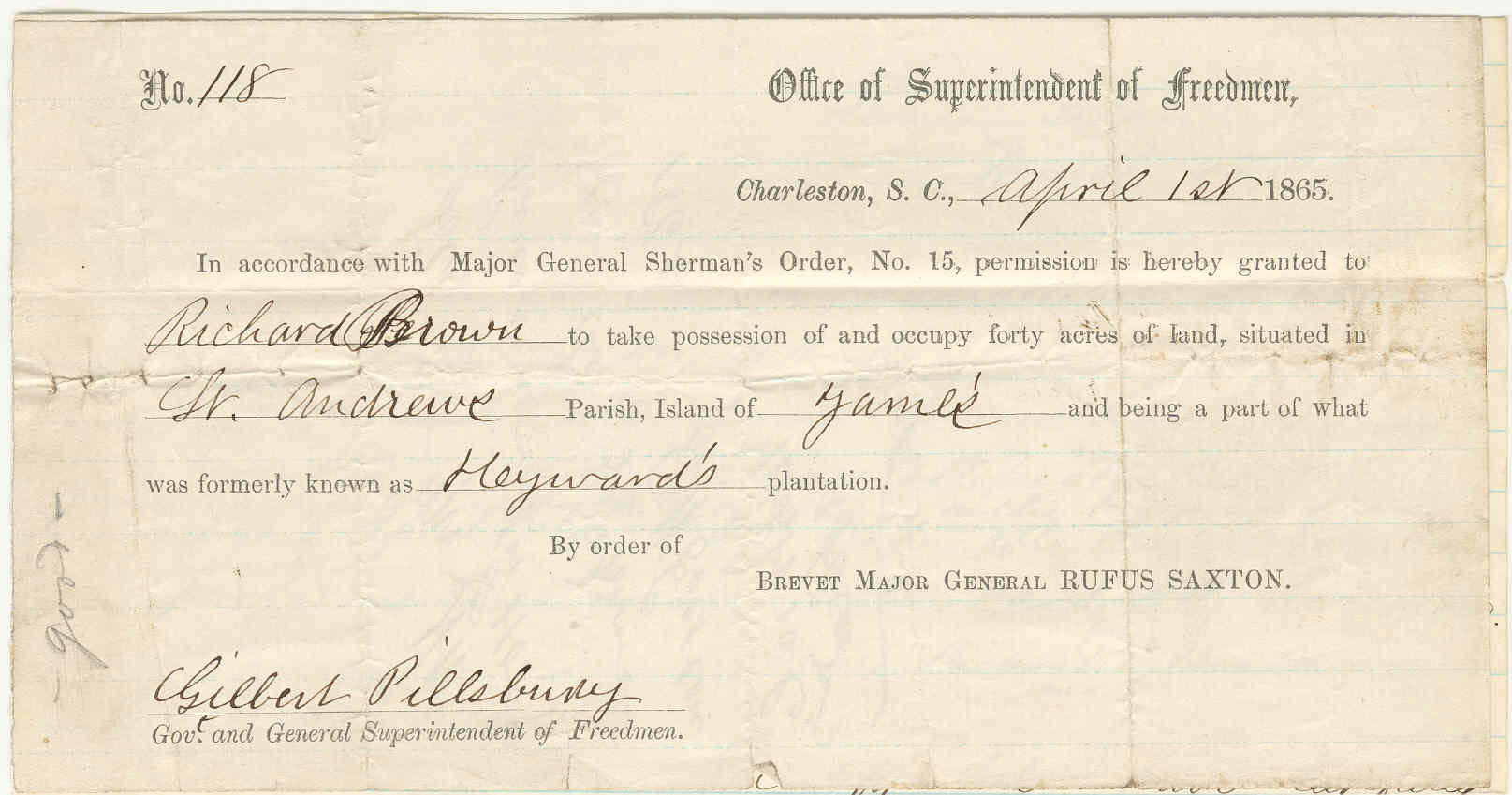
Accessible description: a printed form contains handwritten entries for number, date, recipient, parish, island and former plantation. Official headings and signatures frame the written permission. The key operative wording concerns possession and occupancy. It does not contain an account of Brown’s later harvest, a permanent deed or a later eviction notice.
Sherman’s January 1865 Special Field Orders No. 15 reserved a coastal region extending through parts of South Carolina, Georgia and Florida for settlement by freed families, commonly described as roughly 400,000 acres. Forty-acre plots became an important symbol of the demand for an economic basis of freedom. Brown’s individual certificate is evidence of how that policy could be recorded locally, not proof that all reserved acreage was distributed or that every family received land.
President Andrew Johnson’s restoration policies returned much land to pardoned former owners and undermined these settlements. Freedpeople could face displacement or pressure to work under contracts on land they had expected to hold. Do not infer Brown’s individual subsequent history from the general reversal: a separate record would be needed to establish what happened to his particular occupancy.
Source action: underline the verbs that grant permission. Identify recipient, authority, date, quantity and location. Then write two claims: one this certificate directly supports and one it cannot establish. Explain why a permission to occupy is not the same as unqualified permanent title.
Source B: Circular No. 8, July 17, 1866
Read the Smithsonian institutional transcription, object 2020.26.38, issued by Davis Tillson at Augusta, Georgia, and approved by Oliver Otis Howard. Both numbered paragraphs belong to the selection.
Date note: the catalog’s Date field and the inspected document heading say July 17, 1866. A sentence in the modern catalog description says 1865. This lesson follows the primary heading and flags the catalog discrepancy rather than silently combining dates.
Original guide to paragraph 1: Bureau officers reported that some employers dismissed freedpeople after immediate demand for crop labor declined and refused to pay them. Some allegedly provoked disputes or threatened workers into leaving, then treated departure as contract violation and wage forfeiture. The circular prohibited dismissal without payment unless an employer showed sufficient cause and obtained Bureau consent. Its language also reveals official anxiety about unemployed freedpeople becoming dependent or committing theft; those assumptions are part of the Bureau’s perspective, not facts about the workers.
Paragraph 2 directed military commanders in Georgia to assist Bureau officers in enforcement. That instruction matters: the circular was not merely a moral appeal. Yet an instruction to enforce does not demonstrate that every worker recovered wages or that all officers acted fairly.
Source action: reconstruct the reported mechanism in four steps—seasonal demand changes; employer action; claimed contract consequence; Bureau response. Cite which step comes from a reported abuse and which from a prescribed rule. Add one question about workers’ own accounts that an official circular cannot answer.
Worked comparison: two official records, different purposes
Brown’s certificate authorizes one person’s occupancy under a land policy. Circular No. 8 reports a pattern of employment abuse and tells officials how to respond. Both show governmental intervention in postemancipation economic life. They do not describe the same kind of intervention: the first concerns access to a productive asset; the second concerns payment and dismissal in employment.
A weak comparison says, “Both documents gave everyone forty acres and a wage.” A stronger one says, “One local certificate records an individual permission, while a statewide circular attempts to regulate employer conduct. Their limits of scope and their different legal actions prevent treating either as universal economic security.”
Practice: explain how losing access to land could increase dependence on an employer or creditor without asserting that every displaced person entered the same arrangement. Identify two records needed to test your explanation for one locality: for example, land records and contracts, rather than another general proclamation alone.
A bounded credit example, not a simulation of people
This invented arithmetic example illustrates a crop lien; it is not an actual person’s account. Suppose a farming household receives goods on credit totaling 60 units, then owes 12 units in finance charges. Its contractual share of the crop sells for 65 units. The obligation is 72; the shortfall is 7. The example shows how debt can persist even after a harvest. It does not prove that every contract used this rate, that every farmer had the same yield, or that debt resulted from individual irresponsibility.
Try changing only the sale proceeds to 80 units. The remainder after the stated obligation is 8. Explain why this does not eliminate the importance of land access, bargaining power, recordkeeping and price risk. Do not calculate the monetary value of a person or optimize coercive labor arrangements.
Feedback on the credit example
The arithmetic is 60 + 12 = 72; 65 − 72 = −7, or 80 − 72 = 8. A positive balance in one invented year is not evidence that the historical system offered equal opportunity. A negative balance is not proof of a universal outcome. The example isolates a debt mechanism; historical claims require actual contracts, accounts and contextual evidence.
Source C: Juvenile Convicts at Work in the Fields, 1903
The required photograph belongs to the Library of Congress, Detroit Publishing Company Collection, item det.4a28370. The exact image was inspected in the official framework, printed page 175 (PDF page 182); the independent LOC endpoint was unavailable during preparation, so it is not claimed as separately inspected.
Accessible description: a group of young people in horizontally striped uniforms stands in a cultivated field holding long-handled agricultural tools. Several rows of crops extend behind them toward a distant tree line. Many face the camera. The arrangement and camera-facing poses suggest a composed photograph rather than uninterrupted observation of work. The catalog title identifies them as juvenile prisoners; the visible uniforms alone do not reveal individual charges, ages or conditions outside the frame.
Source action: identify two visible features and explain one claim requiring contextual documentation. Do not infer guilt, consent or satisfaction from a facial expression or pose. Place the image in 1903, not 1865: it can support investigation of a later penal-labor system, not direct observation of a Black Code’s passage.
Source D: North Carolina convict-camp postcard, circa 1910
Read the Smithsonian record for object 2010.36.2. The museum identifies the place as Laurinburg, North Carolina; the handwritten inscription uses a variant spelling. The photographer is unidentified. The date is approximate.
Accessible description: many people wearing striped prison uniforms sit on a small embankment. Dogs appear among them. Several men in civilian clothing stand behind the group, with a tent, a wooden building and trees in the background. A caption identifies a North Carolina convict camp. The catalog reports a reverse-side handwritten count of prisoners, dogs and guards and a racial classification. That annotation is a historical recorder’s claim, not a license for learners to classify individuals’ race from appearance.
Source action: compare this postcard’s portable, captioned format with the 1903 photograph. Explain how an image of incarceration could circulate to viewers distant from the camp. The format supports a question about normalization or spectatorship; it does not prove every recipient’s reaction. Do not conflate a collection’s present catalog description with the original photographer’s intention.
Independent argument and non-graphic route
Write 400–550 words answering: How did land policy, employment rules and penal labor constrain or expand economic freedom after slavery? Use all four required groups, naming the date and type of each. Explain one causal mechanism connecting land access to bargaining power and one mechanism connecting law enforcement to compelled labor. Distinguish sharecropping from crop liens and convict leasing from prison labor generally. Address one counterclaim: legal abolition was a substantial change even where coercion continued.
You may use only the original guides and accessible descriptions; that is the complete non-graphic route. Add a note identifying the guides as paraphrases, not primary quotations. No image viewing, performance or personal testimony is necessary for the response.
Original model and feedback
Abolition changed legal status without distributing economic resources equally. Brown’s April 1865 certificate shows a specific attempt to provide land access: it grants occupancy of forty acres under military authority. Because it is neither a permanent deed nor a later account of possession, it cannot establish lasting security. The broader reversal of land redistribution helps explain why access to land remained a central dispute, but Brown’s own later outcome requires separate evidence.
Circular No. 8, dated July 17, 1866 in its heading, addresses a different constraint. It reports employers manipulating departures to avoid wages and orders Bureau oversight and military assistance. Its existence documents both reported exploitation and an official attempt to restrain it; it does not show uniform enforcement. Sharecropping and crop liens could further tie farmers to landowners and creditors when harvest proceeds failed to cover obligations.
The 1903 juvenile-prisoner photograph and circa-1910 camp postcard extend the inquiry into later penal labor. Uniforms, tools and organized group arrangements make incarceration and work visible, while charges, lease terms and individual experiences remain outside the images. Discriminatory criminal enforcement could channel Black labor into coercive systems, but these photographs alone cannot prove the legal history of each person pictured. Economic freedom therefore depended on assets, contracts, credit, enforcement and collective struggle as well as formal abolition. Recognizing those constraints does not erase abolition’s significance; it explains why freedom remained a material and institutional project.
Feedback: replace “nothing changed” with a comparison of what changed and what persisted. Replace “the picture proves convict leasing” with the specific additional record needed to establish a lease. Keep invented arithmetic separate from historical evidence. If you discuss children, analyze institutional power rather than blaming families or assuming criminal guilt.
Transfer and depth
A fictional archive offers a signed contract and a photograph of a farm crew as proof that all workers were paid fairly. Identify three missing forms of evidence and explain their relevance in 120 words. A contract establishes terms; it does not alone establish payment, freedom to leave or enforcement.
- High-school core: use the concept guide, four-source table and original credit example to support the argument.
- AP depth: analyze all four required sources and explain how purpose, perspective and chronology affect causal claims.
- College extension: compare a public contract with a court or Bureau complaint from the same locality; distinguish a documented relationship from a merely plausible one. Do not research living people or construct a coercion simulation.
Save F3: economic mechanisms and the evidence needed to establish them. Keep the land and labor records available when later evaluating whether constitutional guarantees were implemented.
Public image locator
The exact required reproductions are in the official public course framework. Use the printed/PDF page locators in this lesson; the source images and framework are not redistributed here. The original accessible descriptions support the same comparison without requiring the PDF viewer.
Worked example
Complete the independent task before opening the original model; use diagnostic feedback to revise, recording prior exposure.
Check the reasoning, then transfer it
Loading response history…
Keep your evidence and choose a next step
Loading saved lesson status…
What will you take away?
Keep a private reminder for yourself.
Open your existing lesson notes and evidence.
Loading your journal…