
Freedom movements and contemporary debates
Evaluate movement strategies and contemporary claims through multiple disciplines.
Your task: Evaluate movement strategies and contemporary claims through multiple disciplines.
Open the investigation · Read the explanation · Your saved evidence
Starting recap and vocabulary
A national legal change does not describe every local outcome.
- percentage point
- The arithmetic difference between percentages.
- interdisciplinary inquiry
- Combining methods and evidence from different disciplines while respecting their limits.
How should we compare a movement's goals, methods and results?
Compare two movement strategies through goals, constraints and evidence. Calculate the access rates, distinguish counts from percentages, and write a qualified contemporary claim. Primary-source close reading: Connect the stated protection to a specific public-accommodation example, then identify what enforcement evidence would be needed. Do not turn the fragment into an unsupported statement about all legal fields.
Compare goals and results with an explicit denominator.
Make a provisional claim
Loading saved evidence…
Inspect evidence and test an explanation
The investigation controls appear when your local evidence is ready.
Connect evidence and mechanism
Freedom movements and contemporary debates
How should we compare a movement’s goals, methods and results?
Context and mechanism
Postwar freedom struggles combined legal challenges, grassroots organizing, labor activism, boycotts and many other strategies. Women and local organizers sustained campaigns alongside nationally known leaders. Civil rights legislation changed formal access and federal enforcement while economic and political conflicts continued.
Black Power, feminism, cultural movements and later debates expanded and contested understandings of freedom, identity and community control. These were not one uniform program. Compare stated goals, institutional context and evidence of consequences rather than ranking strategies by slogans.
Contemporary African American life includes varied regions, classes, religious communities, diasporic connections and cultural production. Analyze disparities with appropriate denominators and historical context, while avoiding inferences about an individual’s behavior from group averages. A rigorous inquiry can evaluate an argument without scoring agreement with a political position. State dates and acknowledge unresolved evidence.
Work through the evidence
Fictional policy comparison: service access increases from 30 of 100 households to 60 of 150. Counts double, but the access rate rises from 30% to 40%, a ten-percentage-point increase. Neither count nor rate alone explains the change or its distribution within neighborhoods.
Your investigation
A 1917 protest photograph: observation, context and inference
Before the postwar movements discussed here, people organized public claims to citizenship through marches and images. This photograph offers one earlier case, not proof that later movements had identical goals or conditions. Repair this invented caption: “This photograph counts every participant, proves that nobody spoke, and shows the protest changed policy.”
Capture remains fixed while the draft changes. This is a source-discipline exercise, not a hidden-source test: the lesson already identifies the event. Copy your temporary report before leaving.
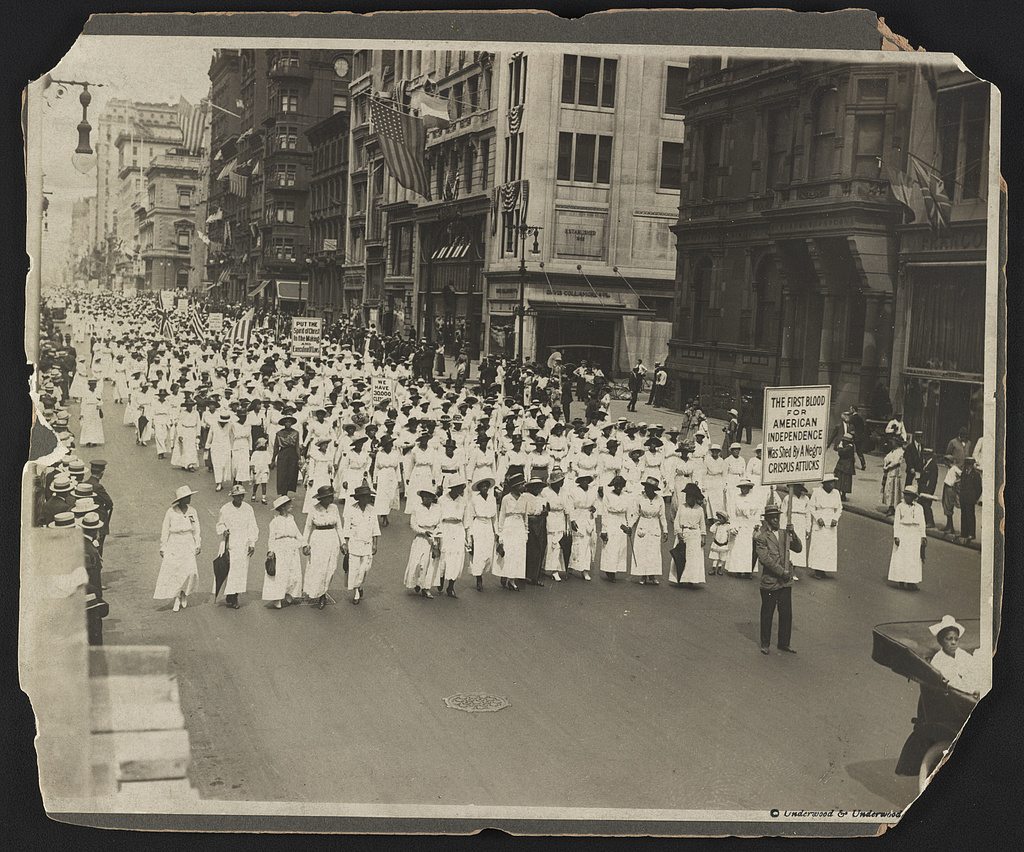
Whole photograph and mount: An elevated view along a city street shows many people in rows, placards, spectators near buildings and flags. The surviving print has an irregular mounted border and a credit at lower right.
Equivalent descriptions of all regions
Whole photograph and mount: An elevated view along a city street shows many people in rows, placards, spectators near buildings and flags. The surviving print has an irregular mounted border and a credit at lower right.
Rows in the foreground and middle distance: People in light clothing and hats are arranged across the street; the procession recedes into the left distance. Occlusion, distance and the image boundary prevent a complete event count.
Right foreground placard: A held placard invokes American independence and Crispus Attucks. Its wording makes a historical political claim; the image does not independently verify that claim or show how every viewer received it.
Buildings, flags and spectators: Tall buildings, hanging flags and people along the sidewalk frame the procession. Their presence does not reveal each spectator’s attitude or identify the photographer.
Keep the evidence basis attached to the claim
0 of12 notes saved. 0 catalog/context notes are outside the currently selected evidence basis. Flags record source scope, not truth or quality; an inference still needs an argument.
Changed case: remove the catalog from your argument
Write one image observation, one attributed catalog fact and one interpretation. Then switch from image-plus-context to image-only. Your notes remain. Revise the caption so it does not silently present the catalog fact as something the camera shows. Return to context and explain precisely what the additional record supports.
Compare your evidence claims and revise
Rows, placards and flags are visible features. A reading that the placard makes a citizenship claim is an interpretation tied to its wording, not a measurement of everyone's motives. The claimant's name and NAACP collection provenance come from the record. Neither source identifies the private attitude of each spectator.
A still frame cannot record silence. The guide describes the march as silent while mentioning drums; this does not prove that no individual spoke at any time. Perspective, overlap, distant figures and the image boundary prevent a complete event census. A sign invokes a historical argument; photographing it does not validate every statement on it.
A photograph documents a selected view, not the whole event or its outcomes. For policy effects, request a dated decision and an evidence trail connecting it to the protest while considering other causes. For organizers' aims, seek their appeal or leaflet; for reception, seek attributed audience reports. Write a second plausible interpretation of the image and name the missing source that could distinguish it.
Copy your image-evidence report
Context opened this visit: no; feedback opened: no. Reset retains both exposure flags; reload clears temporary work and flags. Capture does not certify unseen work. Human review is needed for interpretation quality.
Rights: No known restrictions on publication (Library of Congress advisory). Credit: Library of Congress, Prints and Photographs Division; Underwood & Underwood, copyright claimant; LOT13099, no.28. Local source and integrity record. No blanket worldwide license is asserted.
Compare two movement strategies through goals, constraints and evidence. Calculate the access rates, distinguish counts from percentages, and write a qualified contemporary claim.
Sources and their limits
Civil rights movement archive guide
The collection documents organizing, legal challenges and varied forms of action for equal citizenship.
Authored collection guide; examine individual items for creator, date and purpose.
Consult the source collection or original. Original LearnAI teaching text; not a quotation. External originals retain their own rights.
Access data
Before: 30 of 100 households served. After: 60 of 150 served.
Fictional exercise, not data about an actual community or policy.
Extend and revise
High school: Compare goals and results with an explicit denominator.
AP practice: Develop an interdisciplinary project question, presentation and oral-defense plan; these are practice, not official project scoring.
Introductory college: Write an independent evidence brief that compares interpretations and preserves a revision log.
Which new source would most challenge your argument?
Primary-source close reading: Civil Rights Act: grounds of discrimination
without discrimination or segregation on the ground of race, color, religion, or national origin.
United States Congress, 1964. Read the full source.
Exact concluding words of section 201(a), concerning public accommodation as defined in that section. Read the scope definitions before extending this fragment to every setting.
Your task: Connect the stated protection to a specific public-accommodation example, then identify what enforcement evidence would be needed. Do not turn the fragment into an unsupported statement about all legal fields.
Reasoning to check after writing: The language states protected grounds in the specified public-accommodation context. The rest of the section defines scope; actual access requires implementation evidence.
Worked example
Fictional policy comparison: service access increases from 30 of 100 households to 60 of 150. Counts double, but the access rate rises from 30% to 40%, a ten-percentage-point increase. Neither count nor rate alone explains the change or its distribution within neighborhoods.
Check the reasoning, then transfer it
Loading response history…
Keep your evidence and choose a next step
Loading saved lesson status…