
Choosing senators: Progressive reform and the Seventeenth Amendment
Analyze a 1911 cartoon, compare constitutional selection rules, and trace reform from advocacy to ratification and election.
Your task: Explain what direct election changed, what it preserved and what additional evidence is needed about participation and outcomes.
Open the investigation · Read the explanation · Your saved evidence
Starting recap and vocabulary
A legislature is an elected lawmaking body. Before this amendment, state legislatures formally selected U.S. senators. Reform proposals, constitutional amendments, elections and access to voting are related but distinct questions.
- Direct election
- Selection by eligible voters rather than formal selection by an intervening legislature.
- Ratification
- Approval through the constitutionally required process; proposal alone does not make an amendment valid.
- Election writ
- A formal order directing that an election be held.
- Legislative deadlock
- Failure of a legislature to reach the decision needed to act.
- Visual metaphor
- An image that represents an idea through another object or action, such as a physical struggle standing for political conflict.
How much did changing the chooser change the Senate?
Annotate three visual details in the cartoon, compare original and amended selection rules, then classify the four fictional records. Produce a revised exhibit label with a dated change, a continuity and an explicit limit concerning participation or outcomes.
Identify three visible cartoon details, draw before/after selection chains and repair two overbroad claims.
Make a provisional claim
Loading saved evidence…
Inspect evidence and test an explanation
The investigation controls appear when your local evidence is ready.
Connect evidence and mechanism
Choosing senators: Progressive reform and the Seventeenth Amendment
Try: read an argument in a picture
Look at the cartoon before reading the interpretation below. Identify three things you can actually see: a label, an action and a symbol. Then write what you think the artist wants the viewer to conclude. Keep those observations and interpretations in separate sentences in the source workbench.
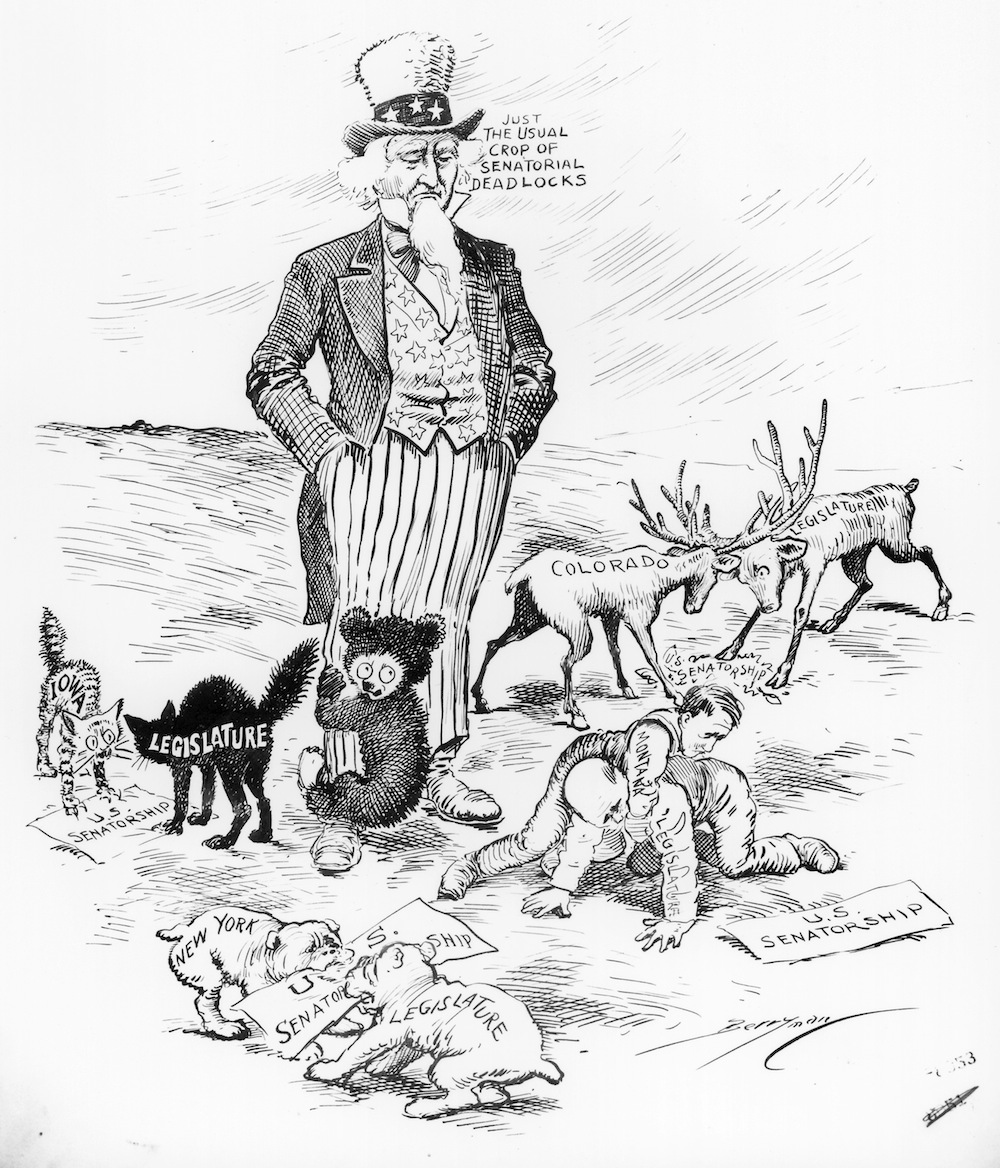
Text alternative: Uncle Sam stands with his hands in his pockets, watching several conflicts. Animals face off near papers marked U.S. senatorship; two people wrestle at the right. Labels connect the struggles to states and legislatures. A small bear clings to Uncle Sam. His words are “Just the usual crop of senatorial deadlocks.” These are features of the drawing, not a count of actual vacancies or a verbatim account of a legislative debate.
A political cartoon compresses an argument. It can make a process look foolish, routine or urgent through facial expression, scale, labels and metaphor. The cartoon is a contemporary source for how a problem was represented. Its existence does not establish that everyone agreed with the criticism or that the proposed cure would succeed.
Predict: which part of the institution changes?
Before the amendment, the Constitution assigned formal selection of senators to state legislatures. The question for this lesson is not whether voters had any political influence before 1913. It is which institution made the formal choice, how reformers sought to change it and what the amendment actually altered.
Draw two chains, using words or boxes:
Original formal route: eligible voters choose state legislators → legislature chooses a U.S. senator.
Amended formal route: eligible voters choose a U.S. senator directly.
These sketches identify the selection mechanism. They do not show every nomination practice, campaign influence, voting barrier or vacancy procedure. Add a separate branch for vacancies after reading the relevant card. Do not force that exception into the ordinary-election chain.
Experiment: test a reform slogan against the text
The slogan “the people now choose” identifies an important change, but does it answer every question? Complete the comparison below. For each row, explain whether the amendment changed the rule, preserved it or left a further question requiring evidence.
| Question | Original text or process | Amendment or evidence task |
|---|---|---|
| Who formally chooses senators? | State legislature | Identify the replacement chooser and the qualification language. |
| How many senators represent each state? | Two | Check whether this changes. |
| How long is an ordinary term? | Six years | Check whether this changes. |
| What happens during a vacancy? | Original recess appointment provision | Separate an election writ from a legislature-authorized temporary appointment. |
| What happens to an already chosen senator? | A term is in progress | Read the transition clause before predicting immediate removal. |
| Who can actually vote? | Requires dated qualifications and access evidence | Separate formal selection reform from universal participation. |
The original and amended provisions are supplied through the National Archives Constitution transcript and Seventeenth Amendment transcript. Source cards from the same text are not independent corroborating witnesses.
Now classify the four fictional record fragments. A popular-choice poll is not automatically a completed formal election. A congressional proposal is not ratification. A vacancy is not proof that an appointment is authorized. An amendment’s effective date does not mean every earlier term ended that day. For each fragment, preserve the strongest supported claim and identify one missing record.
Compare the four record interpretations
A — popular-choice poll: the fragment documents a preference mechanism. To establish the formal choice under the earlier system, seek the legislature’s election record and the applicable state procedure. State experimentation could influence selection without itself changing the federal Constitution.
B — congressional proposal: the document records a proposed constitutional change. The ratification stage remains unverified in this fragment. Do not treat the word “amendment” in a proposal’s title as proof that the amendment had already become valid.
C — vacancy: the constitutional text supplies an option for state-authorized temporary appointments. Without the state authority, neither permission nor prohibition is established for this fictional case. An election writ and an appointment are different actions.
D — existing term: the transition clause matters. A senator chosen before the amendment became valid did not lose that election or term merely because the selection rule changed. Do not invent a simultaneous replacement of the entire Senate.
These are worked applications of the supplied texts, not determinations about present-day state election law.
Understand: pressure, experimentation and constitutional change
Progressive reform was a varied set of efforts to address problems associated with concentrated power, industrial society and public administration. Political reforms could seek more direct participation, different administrative procedures or new regulation. The senatorial-selection case is one strand, not a definition of everything called Progressive.
The supplied Senate history describes legislative deadlocks, state experiments and advocacy. Use those as propositions to investigate, not as a claim that one cartoon caused an amendment. An interpretation can connect a reported problem to a proposed mechanism: moving the formal choice out of a legislature could address the particular problem of legislative selection deadlock. That mechanism does not logically guarantee an end to all corruption, campaign influence or political conflict.
Build a timeline that separates pressure for change, state practice, congressional proposal, ratification and a subsequent election. The packet dates the proposal to 1912, ratification to April 1913 and the named Bacon election to July 1913. The Senate’s retrospective account identifies that election as implementation under the amendment. It does not supply the election return or a representative study of participation.
Do not make every event in the timeline a necessary cause of the next. To strengthen a causal argument, inspect contemporary petitions, legislative debate, competing proposals and state records. Ask what an opponent claimed and what evidence would challenge your explanation. The image supplies a political framing, while the texts supply institutional rules; neither alone measures policy success.
Compare participation with selection
A new route to choosing officeholders can matter without settling who can use it. The amendment links voter qualifications to those for the most numerous branch of the state legislature. That wording is a reason to investigate the electorate, not to assume every adult resident could vote. Registration rules, enforcement, intimidation and actual turnout require dated evidence of their own.
Keep three questions distinct: who was legally qualified, who could exercise that qualification in practice, and who cast a ballot. An election total cannot supply all three denominators. Equally, equal numbers of senators per state do not imply equal population per senator. The continuity in state representation should appear beside the change in selection when you explain the reform.
Apply: a new appointment record
The transfer case supplies a state authorization and an appointment but no election return. Write what the added authority resolves before answering. Then name what remains unverified. This is a different evidentiary situation from record C, where the state authority was missing.
For your exhibit, combine one annotated detail from the cartoon, one changed rule, one preserved rule and one limit about participation or outcomes. Cite the source IDs. A useful conclusion should explain a mechanism rather than simply declaring the reform democratic or undemocratic without defining the comparison.
High school: label three visual details, complete the comparison and revise two claims that go beyond the evidence.
AP practice: explain continuity and change, contextualize reform pressure and distinguish a source’s argument from independent evidence of results. This is bounded practice within a larger Progressive-era topic, not complete AP coverage.
Introductory college: investigate one state’s sequence using nomination, legislative, ratification and election records alongside contemporary advocacy and opposition. Explain source selection, institutional stages and the limits of your measure of participation.
Worked example
Fictional record C describes a vacancy but omits state authorization. The amendment permits a legislature to empower the executive to appoint temporarily. A careful conclusion is that the constitutional option exists, while this state’s applicable authority is unverified. Neither “the governor certainly can appoint” nor “all appointments are forbidden” follows.
Check the reasoning, then transfer it
Loading response history…
Keep your evidence and choose a next step
Loading saved lesson status…