

Religious revival: organization, participation and autonomy
Read a camp-meeting plan, compare religious claims about agency, and trace institutional responses without equating attendance with equality.
Your task: Explain revival organization using spatial and textual evidence while distinguishing author claims, source dates, participation and institutional autonomy.
Open the investigation · Read the explanation · Your saved evidence
Starting recap and vocabulary
Religious revivals sought renewed commitment and conversion. Camp meetings gathered people for extended outdoor worship. Denominations, congregations and voluntary associations were related but different organizations; their practices and beliefs varied.
- Revival
- An effort or period of renewed religious commitment, understood differently by historical participants.
- Denomination
- An organized religious body within a broader tradition.
- Agency
- The capacity or action attributed to an actor; theological and historical explanations may use it differently.
- Collation
- Systematic comparison of textual witnesses or editions to identify differences.
What can a meeting’s layout and a preacher’s instructions reveal—and what can they leave unknown?
Annotate a historical plan, separate organizing methods from theological claims, build an event/source timeline, and write an evidence-based explanation with an unfamiliar transfer.
Label the plan and use an event/source timeline to support a short explanation.
Make a provisional claim
Loading saved evidence…
Inspect evidence and test an explanation
The investigation controls appear when your local evidence is ready.
Connect evidence and mechanism
Study a religious movement as history
A historical investigation asks what people believed, organized, represented and changed. It does not require you to affirm a belief, practice worship, disclose your religion or decide whether a conversion was spiritually authentic. Use respectful attribution: “Finney argues…” identifies whose claim you are analyzing.
Early nineteenth-century revivals took different forms across regions and denominations. Camp meetings brought people together for extended outdoor gatherings. The Library of Congress exhibition provides context for this organizational form. This lesson combines one 1809 plan, a later textual witness to Finney’s lectures, and an institutional account of the AME Church. They are not records of one meeting or a complete history of American religion.
Try: read the arrangement before explaining it
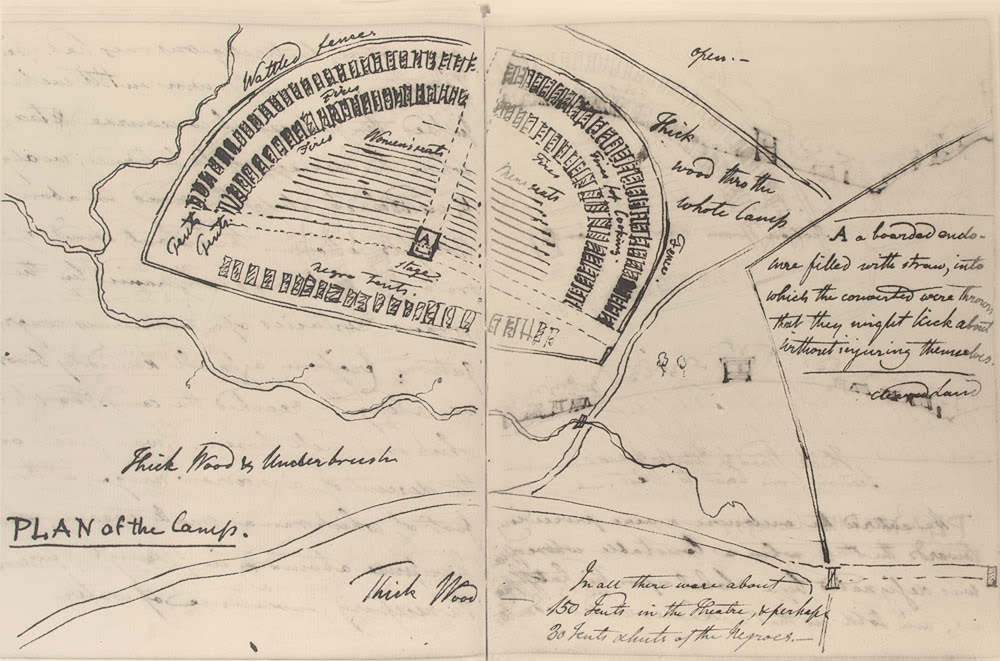
Create three columns: visible arrangement / observer’s annotation / inference needing another record. Locate seating, tents and the preaching area. Describe one separation without treating it as evidence that everyone accepted the arrangement. Do not count tent symbols as people or infer an exact attendance from an approximate note.
Text description and spatial-evidence check
Tents form curved rows around seating and a central speaking area. Men’s and women’s seating are labeled separately. A row of tents carries a racial designation, recording segregation within the represented gathering. Woods, water and roads surround the main space, and an enclosure is described at the side. This description supports the same classification task without requiring small-handwriting recognition. A spatial plan can show how its maker represented organization; it cannot by itself establish every person’s experience, beliefs or leadership rights.
The handwritten enclosure description is Latrobe’s characterization of conduct. Attribute it to him rather than converting it into the participants’ own account. To investigate what occurred, compare participant testimony, other observers and the circumstances in which the sketch was made. Do not reenact distressing behavior or assign classmates roles within racial segregation.
Predict: does organization exclude religious agency?
Read the complete selected Finney passage in Experiment. Mark the words describing human use of means, then the qualification concerning divine blessing. Draw two boxes connected by an arrow labeled Finney’s stated relationship, not a proven causal law. Explain what a headline quoting only the first sentence would omit.
Check Finney’s two-part argument
The passage argues that appropriate means matter while also insisting on divine blessing. It therefore cannot fairly be reduced to either “technique guarantees conversion” or “human effort does not matter.” The source is evidence of a religious argument. Historical research can examine organizing practices, circulation and reported responses without certifying or disproving divine action.
Experiment: repair a misleading source date
An invented worksheet labels the passage “Exact words printed in 1835, describing the Fairfax meeting of 1809.” Use the source cards to correct both claims. The lecture and plan concern different authors and contexts. The supplied transcription’s copyright notice names 1868; it is a later textual witness, not a verified first-edition transcription.
| Date | What it identifies | What it does not establish |
|---|---|---|
| 1809 | Date attached to Latrobe’s plan | Date of Finney’s lecture passage |
| 1816 | AME denominational organization in the institutional history | A consequence of this particular Virginia meeting |
| 1835 | First publication of Finney’s lecture collection | Exact wording of every later edition |
| 1868 | Copyright notice in the supplied textual witness | Exact printing date of this copy or a date of revival attendance |
Consult the 1835 bibliographic record and the supplied title/copyright transcription. To quote exact 1835 wording, obtain that edition and collate the passage. A useful later source need not be discarded, but its date and evidentiary role must be honest. Place event dates on one timeline and source-production dates on another.
Understand: participation and autonomy are different questions
A shared religious gathering need not confer equal authority. The plan’s divisions make that a question to investigate. The AME institutional history describes Black congregations organizing a denomination under Richard Allen in 1816. Treat these organizers as historical actors building institutions, not only as people acted upon.
Make a relationship diagram with congregation → representatives → denominational organization. Compare it with the meeting-space diagram. One addresses institutional governance; the other addresses a represented gathering. The supplied materials do not prove that the Fairfax event caused the Philadelphia organization. A plausible connection between broader exclusion and autonomy is not permission to invent a direct chain between unrelated local records.
Now investigate a possible reform connection. Draw religious association → proposed civic or social reform → organized action → institutional response. Leave unsupported arrows marked as questions. Connect to the reform-source investigation and identify a specific record that could demonstrate shared organizers or a stated religious motivation. Neither temporal overlap nor the word “reform” proves that all movements shared a theology or political program.
Apply: write an account with explicit boundaries
Write a 180–250-word explanation of how revival-era religion involved organization and contested participation. Use the plan, the complete Finney excerpt and the institutional account. State which source is later than the main events. Explain one practice, one claim about agency and one limit of your evidence. Preserve your first interpretation and show one revision in the notebook.
Before finalizing, challenge these overclaims: “everyone attended,” “everyone participated equally,” “every revival followed one method,” and “religious activity always produced the same reform politics.” Name the kind of evidence needed for each. A denomination’s account is valuable institutional testimony, but its modern narrative still needs comparison with dated records for a fuller investigation.
Transfer: invitation, layout and actual participation
In a fictional voluntary association, a printed invitation welcomes all residents. A seating plan divides the hall into two sections. A committee minute says the invitation was approved, but no attendance register, admission record or leadership list is supplied. Classify invitation, represented space and authorized action. Write a claim that uses the evidence without equating an inclusive invitation with equal access or authority.
Check the unfamiliar association
The packet establishes the invitation’s wording, represented division and recorded committee approval. It does not establish who arrived, who was admitted, what either section meant, or who could speak and vote. Seek rules and participant accounts before interpreting the division. This invented association is a transfer exercise; it is not a substitute for the historical plan’s explicitly labeled social divisions.
High school: use the three-column observation chart and two timelines. AP practice: connect revival organization and religious autonomy to social change with specific evidence and limits. Introductory college: collate editions and inspect an original institutional or participant record, documenting disagreement and source dependence.
The broader topic still requires varied denominations, women’s religious authority, Indigenous religious life, Catholic and Jewish communities, dissent, reform networks and sources from different regions. This packet establishes bounded inquiry, not one national religious experience or complete coverage of the Second Great Awakening.
Worked example
The plan shows separated seating; that supports a claim about the represented arrangement. It does not establish every participant’s beliefs or prove equal leadership. Finney’s passage describes appropriate means together with divine blessing; removing the qualification changes the argument being analyzed.
Check the reasoning, then transfer it
Loading response history…
Keep your evidence and choose a next step
Loading saved lesson status…